

Weight-loss injections such as Wegovy, Ozempic, and Mounjaro are primarily associated with weight loss and the treatment of obesity. However, another potential effect is now coming into focus: Could GLP-1 medications also improve fertility in some women? There are particularly interesting indications of this in cases of obesity and PCOS. For women hoping to conceive, however, this does not mean that these medications can be used as a fertility treatment.
Why Weight Loss Can Affect Fertility
So-called GLP-1 receptor agonists and related active ingredients have transformed the treatment of overweight and obesity. Semaglutide, the active ingredient in Wegovy and Ozempic, as well as tirzepatide, the active ingredient in Mounjaro, can reduce appetite and lead to significant weight loss. In the European Union, Mounjaro is used for both the treatment of type 2 diabetes and weight management. Wegovy is approved for weight management. However, as these medications become more widespread, another question arises for women of childbearing age: What happens to fertility when weight, metabolism, and possibly the menstrual cycle change?

A recent scientific review from 2026 concludes that there is evidence of positive effects on certain reproductive parameters, particularly in women with polycystic ovary syndrome (PCOS) and those who are overweight. At the same time, the authors emphasize that the data are not yet sufficient to recommend GLP-1 medications as a fertility treatment. The potential link does not necessarily stem from the medication itself, but rather from metabolism. Being overweight or obese can affect hormonal balance and the menstrual cycle in some women. In PCOS in particular, insulin resistance, elevated androgen levels, and irregular or absent ovulation can reduce the likelihood of pregnancy.
If a woman loses weight through treatment and her metabolic status improves at the same time, her menstrual cycle may also change. Some women begin to ovulate more frequently again. This is precisely why it is possible that, after successfully losing weight, a woman may suddenly start ovulating more regularly again and thus find it easier to become pregnant. However, this does not automatically mean that GLP-1 medications themselves are a “fertility treatment.” There is strong evidence suggesting that some of the observed effects are mediated by weight loss and improved insulin sensitivity. Research is also investigating the direct biological effects of GLP-1 signaling pathways on the reproductive system.
Of Particular Interest: Women with PCOS
Polycystic ovary syndrome, or PCOS for short, is one of the most common hormonal causes of menstrual cycle irregularities and can be associated with infertility in some women. In affected women, irregular or absent ovulation can reduce the likelihood of pregnancy. At the same time, PCOS frequently occurs alongside obesity and insulin resistance. This is precisely why research is currently underway to determine whether GLP-1 receptor agonists might have positive effects on hormonal balance and reproductive function in women with PCOS, in addition to promoting weight loss. Weight loss and improvements in glucose and insulin metabolism can cause the menstrual cycle to change and become more regular in some women. As a result, ovulation may also occur more frequently again.
Research to date provides interesting insights into this, but the findings are not yet conclusive. A systematic review and meta-analysis published in 2026 evaluated 11 randomized controlled trials on GLP-1 receptor agonists in women with PCOS. The researchers found a moderate short-term effect on body weight. However, for reproductive factors such as the regularity of the menstrual cycle, the quality of the available data was insufficient to draw reliable conclusions. Another meta-analysis also compared GLP-1 medications with metformin. Among other things, it showed improvements in certain male hormones and in insulin resistance. Such changes could, in principle, be relevant for women with PCOS because metabolism and hormonal balance are closely linked to ovulation. However, a direct increase in pregnancy or live birth rates cannot be inferred from this.
The current body of research therefore suggests a possible indirect influence on fertility, particularly through weight loss and an improved metabolic profile. Whether GLP-1 medications also have an independent effect on the ovaries, ovulation, or fertility has not yet been conclusively determined. GLP-1 medications should therefore not currently be considered a fertility treatment for PCOS. Women with PCOS who wish to conceive should discuss treatment on an individual basis with their doctor or a fertility clinic.
Semaglutide and Fertility: First New Data
Recent studies on semaglutide are particularly intriguing. A multicenter real-world cohort study published in 2026 examined women who were overweight or obese and had existing infertility, and who had been treated with semaglutide prior to fertility treatment. The study focused on reproductive outcomes following this pretreatment. Such data are interesting because they bring the question closer to the reality of fertility medicine. However, they are not yet sufficient to conclude that semaglutide directly increases the chance of pregnancy.
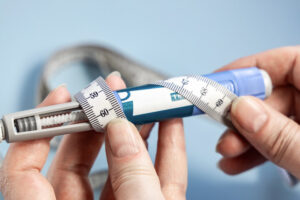
For example, if a woman loses weight as a result of the treatment, this alone can alter her hormonal and metabolic status. Whether the medication has an independent effect on fertility beyond this has not yet been clarified. A recent study from the U.S. is also specifically examining semaglutide in relation to reproductive changes in women with PCOS—or, as it is termed there, “polyendocrine metabolic ovarian syndrome.” The initial results are described as promising; however, these are early data and do not constitute proof of improved fertility.
Can the Weight-loss Injection Help You Get Pregnant Faster?
This is a question that naturally arises from observations to date—but the answer is: possibly for certain women, though not as a direct or guaranteed effect of the medication. If a woman previously had irregular ovulation due to obesity, insulin resistance, or PCOS, and this situation improves through weight loss and better metabolic health, the likelihood of a spontaneous pregnancy may increase.
This can also happen unexpectedly. A woman who has had irregular cycles for a long time should therefore not assume that she cannot get pregnant because of her irregular cycle. If her cycle changes as a result of weight loss, the likelihood of pregnancy may also change. However, the medications themselves are not approved to increase fertility. Anyone hoping to become pregnant should therefore not start taking a GLP-1 medication on their own.
Weight-loss Injections are Not Fertility Drugs
That is the crucial point. Even though initial studies show positive effects on the menstrual cycle, ovulation, and pregnancy rates, this does not mean that women hoping to conceive should now be prescribed a weight-loss injection to get pregnant more quickly.
The research to date is still too inconsistent for that. A recent evidence review on GLP-1 medications for PCOS describes promising signs but also points to significant gaps in knowledge. For tirzepatide in particular, there is currently very little specific data on PCOS and fertility.
These medications are primarily intended for the treatment of obesity or certain metabolic disorders. Any potential improvement in fertility—if it actually occurs—would be more of an additional benefit for certain patients.
What Should you Consider If You’re Planning to Conceive?
As soon as a pregnancy is planned, the situation changes fundamentally. GLP-1 medications should not be used during pregnancy. Therefore, treatment must be planned well in advance if you’re planning to conceive.

For tirzepatide, for example, the European product information states that the medication should be discontinued at least one month before a planned pregnancy. The active ingredient has a relatively long half-life.
For semaglutide, the European product information recommends a significantly longer period: treatment should be discontinued at least two months before a planned pregnancy.
This is an important consideration when planning to conceive. If treatment is not discontinued until after a positive pregnancy test, there may already have been exposure during an early stage of pregnancy. This does not automatically mean that harm has occurred. However, it does mean that the transition from weight-loss therapy to a planned pregnancy should be discussed in advance with the treating physician.
Particularly Important for PCOS
The situation can be especially complicated with PCOS. Weight loss can help a woman resume regular ovulation, potentially allowing her to become pregnant more quickly. At the same time, GLP-1 therapy must be discontinued before a planned pregnancy. This means that the phase in which fertility improves may coincide with the phase in which the woman stops her treatment.

When trying to conceive, therefore, body weight should not be the only factor considered. Other crucial factors include the menstrual cycle, ovulation, metabolism, existing medical conditions, and the question of which treatment is appropriate after discontinuing the GLP-1 medication.
What Happens After Discontinuation?
Another aspect that is often underestimated when planning to conceive is the period following discontinuation. GLP-1 medications can be very effective for weight management. However, weight gain may occur again after discontinuation. The extent of this gain varies from person to person. For women with PCOS, this can be relevant because weight and metabolism, in turn, can influence the menstrual cycle and ovulation.
Planning for pregnancy should therefore not focus exclusively on the period during which the medication is being taken. Instead, it makes more sense to develop a long-term plan that takes into account diet, exercise, metabolism, and, if necessary, alternative treatments.
This Topic May Also be of Interest to Men
The connection between GLP-1 medications and fertility does not affect women exclusively.
In men, being overweight, insulin resistance, and metabolic disorders can also be linked to changes in sperm quality and reproductive health. Improving metabolic health and losing weight could therefore theoretically have positive effects on certain reproductive parameters in men as well.
However, the available data is significantly less extensive here than for women with PCOS. A recent review suggests possible indirect improvements through metabolic changes but also emphasizes that further studies are needed.
Another Point: Contraception May be Affected
When trying to conceive, the transition phase before the planned pregnancy is also important. Tirzepatide can affect the absorption of orally taken medications because it delays gastric emptying. For women who are overweight or obese, the European product information therefore recommends using a barrier method in addition to tirzepatide for four weeks after starting treatment and after each dose increase, or switching to a non-oral method of contraception.

This does not mean that tirzepatide generally negates the effectiveness of the birth control pill. However, there is a period during which the reliability of oral hormonal contraception may be compromised. This point should be taken into account during a medical consultation, especially for women who do not currently wish to become pregnant but are planning a pregnancy in the future.
The Research is Promising -But Not Yet Conclusive
The current picture is therefore more complex than the simple statement “weight-loss injections make you more fertile.” There is now several lines of evidence suggesting that GLP-1 medications may be associated with improvements in metabolism, more regular menstruation, and more frequent ovulation in certain women—particularly those who are overweight, have insulin resistance, or have PCOS. Some studies also report higher pregnancy rates.
However, it remains unclear just how significant the direct impact of these medications on fertility actually is. Furthermore, there is a lack of larger, long-term studies specifically focused on women seeking to conceive. A recent review of the evidence therefore reaches a cautious conclusion: GLP-1 medications are of scientific interest for certain women with PCOS and metabolic issues, but cannot currently be considered an established treatment for PCOS or a standalone fertility therapy.
What Women Trying to Conceive Should Know
Anyone taking a GLP-1 medication who wishes to become pregnant should discuss their plans early on with their treating physician. The following points are particularly important:
- Which active ingredient is being used? Semaglutide and tirzepatide have different pharmacological properties and different recommendations.
- Why is the medication being taken? Treatment for obesity must be planned differently than treatment for type 2 diabetes.
- How regular is the menstrual cycle? Changes may indicate that ovulation has also changed.
- Is there PCOS or another cause for difficulty conceiving?
- When should treatment be discontinued?
- What treatment or support will follow afterward?
If you are trying to conceive, you should therefore not stop taking the medication on your own and without medical supervision!
Interesting for Fertility, But Not a Fertility Drug
Research on GLP-1 medications and fertility is advancing rapidly. Particularly in women who are overweight and have PCOS, there are initial indications that treatment with GLP-1 receptor agonists can positively influence the menstrual cycle and ovulation through weight loss and improved metabolic markers. Some studies even report higher pregnancy rates. However, it has not yet been conclusively determined whether the medications themselves have a direct fertility-enhancing effect.
For women hoping to conceive, the following applies: A weight-loss injection should not be used on one’s own with the goal of getting pregnant more quickly. If a GLP-1 medication is already being used, the desire to conceive should be discussed with a doctor early on. This is especially true in cases of PCOS, diabetes, or severe obesity. Together, you can determine whether and for how long the treatment is appropriate, when it should be discontinued, and how the period leading up to the planned pregnancy can be medically supported. In general, a doctor should always be consulted before starting any medication. Current research offers hope for new possibilities—but this does not yet mean that GLP-1 medications have become standard fertility treatments.
You may also be interested in...
-

Having a baby is a special time for many couples. For some couples, having a…
-
In our 24/7, always-on world, light pollution is a given. Streetlights, store lights, continuously lighted…
-
Many people understand that being overweight or underweight can have an impact on men and…