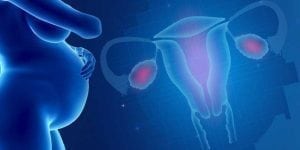

When a pregnancy repeatedly fails to occur despite the desire to have a child, attention often turns first to the eggs or the quality of the embryos. Especially in fertility treatment, there is a lot of discussion about which embryo has the best chance of resulting in a pregnancy.
But even a viable embryo needs more than just a good genetic foundation. It must implant in a uterus whose lining is receptive at the right time. It is precisely this so-called endometrial factor that is increasingly becoming the focus of research.
A recent review article from 2026 shows just how complex the processes in the uterine lining are and why a uterus that appears normal during examinations does not automatically mean that conditions for successful implantation are optimal.
The Uterus Must be Ready at the Right Time
The uterine lining, or endometrium, changes during each menstrual cycle. Under the influence of estrogen, it first thickens. After ovulation, progesterone plays a key role, ensuring that the tissue prepares for a potential pregnancy. The endometrium is particularly receptive to an embryo only during a limited period of time. This period is often referred to as the “implantation window.”
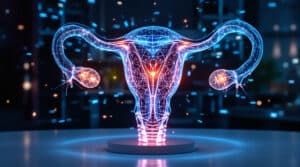
Implantation is not a passive process. The embryo and the endometrium must communicate with each other. At the same time, cells of the endometrium, blood vessels, and immune cells undergo changes. Hormonal regulation must also be precisely coordinated. If any of these processes are disrupted, implantation may be impeded—even if the transferred embryo is otherwise well-suited for implantation.
When Multiple Embryo Transfers Are Unsuccessful
The issue of the uterus becomes particularly relevant in cases of recurrent implantation failure. This refers to a situation where pregnancy does not occur despite multiple embryo transfers.
The problem: Recurrent implantation failure is not a single, isolated condition. There can be a wide variety of underlying causes, including anatomical changes in the uterus, hormonal factors, alterations in immune regulation, or abnormalities in the development and maturation of the endometrium.
For this reason, it is not possible to determine with a single test whether the uterus is the “culprit.” Current research is instead focused on identifying which biological processes might actually be disrupted in each individual patient.
Not Every Abnormality is Visible on an Ultrasound
An ultrasound examination can detect important changes. These include, for example, fibroids, polyps, or certain uterine malformations. However, the function of the endometrium cannot be fully assessed based on its external structure. A uterus may appear normal on ultrasound, while processes at the molecular or cellular level may still be altered.
This is precisely one of the major challenges facing current research: How can we reliably determine whether the endometrium is actually optimally prepared for implantation? A 2026 review article points out that while established examination methods can detect structural changes, more subtle molecular and cellular abnormalities are significantly more difficult to identify.
Hormones Play a Central Role
For the endometrium to become receptive, estrogen and progesterone, in particular, must interact at the right time. After ovulation, progesterone ensures, among other things, that the endometrium undergoes functional changes and prepares for potential implantation. In certain forms of implantation failure, researchers therefore examine whether the endometrium responds adequately to progesterone.
So-called decidualization also plays a role. In this process, endometrial cells undergo changes to create the conditions necessary for implantation and the early development of pregnancy.
If this process is disrupted, it could make it more difficult for an embryo to implant. Researchers are therefore increasingly examining not only hormone levels but also how the tissue responds to these hormones.
Immune Cells Are also Involved
The uterus is not a biologically passive environment. The endometrium contains numerous immune cells that change throughout the menstrual cycle and communicate with the cells of the endometrium.

This is particularly interesting because, after fertilization, the embryo carries the father’s genetic material and is therefore not completely identical to the mother’s own body in the eyes of the maternal immune system. Nevertheless, the uterine environment must facilitate successful implantation.
Research therefore focuses, among other things, on so-called uterine natural killer cells, cytokines, and other signaling molecules. This does not mean that the immune system is simply “turned off” during pregnancy. Rather, there must be finely tuned communication between immune cells, hormones, and the cells of the uterine lining.
Blood Supply to the Lining and Chronic Inflammation Play a Role
The blood vessels of the endometrium also play a role. The endometrium must change throughout the menstrual cycle and receive adequate blood flow, while numerous remodeling processes take place simultaneously. Current research therefore also considers vascular function and the communication between blood vessels and endometrial cells as possible factors in implantation problems. This highlights why successful implantation depends on many processes occurring simultaneously. The embryo alone does not determine whether a pregnancy occurs.
Another possible cause is inflammatory changes in the uterine lining. Chronic endometritis—that is, a long-lasting inflammation of the endometrium—is of particular interest. It can progress relatively unnoticed and does not necessarily have to be accompanied by obvious symptoms. In certain patients with recurrent implantation failure, tests are therefore conducted to determine whether such a condition is present.
However, one should not conclude from this that every woman with an unsuccessful embryo transfer must be tested for chronic endometritis. Current research emphasizes, rather, that diagnostic testing should be used selectively and that not every theoretically possible cause needs to be automatically investigated or treated.
Why There Is No Simple Test Yet
The major problem is that the endometrium is not a static tissue. It changes throughout the menstrual cycle and responds to hormones, immune processes, and numerous local signals. Therefore, a test result can also depend on when the test is performed.
In addition, recurrent implantation failure can have various causes. One patient may have an anatomical problem, while another may have a hormonal or inflammatory change. In a third patient, no clear cause can be found despite extensive testing.
A recent review therefore suggests that recurrent implantation failure should not be viewed as a single disease, but rather as a heterogeneous problem with various biological causes.
What Does this Mean for Fertility Treatment?
The increasing focus on the endometrium does not mean that the embryo is unimportant. On the contrary: embryonic and maternal factors must be compatible. However, advances in reproductive medicine have shown that even a very good embryo does not automatically lead to a pregnancy. For this reason, there is a growing effort to determine whether specific abnormalities in the uterine lining can be identified and treated in certain patients.

Caution is key here. Not every additional test automatically improves the chances of having a baby. In its latest statement on recurrent implantation failure, the American Society for Reproductive Medicine (ASRM) also points out that diagnostics should be targeted and that the evidence supporting various additional tests and treatments varies in strength.
Personalized Diagnostics Instead of One-Size-Fits-All Testing?
This could be a key development in the coming years. Instead of searching for the same potential causes in all patients, fertility medicine could focus more on determining, based on individual medical history and previous treatment outcomes, which biological factor might actually be relevant.
In the future, new molecular testing methods may be able to more accurately assess how receptive the endometrium is at a specific point in time and which signaling pathways in the endometrium are altered. However, many of these approaches are still in the research phase.
The Uterus Is Taking Center Stage
This new research is thus also changing the perspective on infertility. If an embryo repeatedly fails to implant, the cause does not necessarily lie with the embryo itself.
The environment in which implantation is supposed to take place can also be decisive. The endometrium must undergo changes at the right time, respond to hormones, communicate with immune cells, and create the necessary conditions for early pregnancy.
Many of these processes are not yet fully understood. Yet this is precisely where one of the most exciting developments in modern reproductive medicine lies: The question is no longer just which embryo has the greatest potential, but increasingly whether the uterus is optimally prepared to receive it at the decisive moment.
Conclusion
In the establishment of a pregnancy, the uterus is far more than a passive “shell” for the embryo. Its lining undergoes complex hormonal, immunological, and structural changes before implantation is even possible.
In cases of recurrent implantation failure, factors related to the endometrium may therefore also play a role. At the same time, research has not yet advanced to the point where a clear cause can be determined for every patient or where a single test can predict the perfect ability for implantation.
Developments are therefore increasingly moving toward more targeted and individualized diagnostics. For couples struggling to conceive, this could mean in the long term that not only the embryo will be examined more closely, but also the biological environment in which a pregnancy is to begin.
You may also be interested in...
-
Even if an egg has been fertilized, pregnancy is far from certain. In the first…
-

Uterine fibroids can interfere with the process of egg fertilization and can also prevent proper…
-
Every day, giant strides are made in organ transplant research, but now a new experiment…