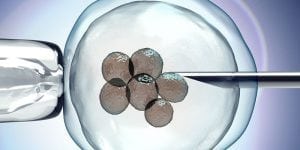
Even if an egg has been fertilized, pregnancy is far from certain. In the first few days after fertilization, the embryo continues to develop and travels toward the uterus. There, another crucial hurdle awaits: it must successfully implant itself in the uterine lining.
This process is called implantation and is one of the most complex early stages of pregnancy. For a long time, the uterus was viewed primarily as a kind of “surface” on which the embryo attaches. Today we know that this view is too simplistic. Rather, an intense exchange of molecular signals takes place between the early embryo and the uterine lining. Both sides must, in a sense, be in sync for implantation to succeed.
The Uterus Must be Ready at the Right Time
In order for an embryo to implant, the uterine lining—known as the endometrium—must undergo specific changes during the menstrual cycle. After ovulation, the hormone progesterone, in particular, ensures that the lining prepares for a potential pregnancy.
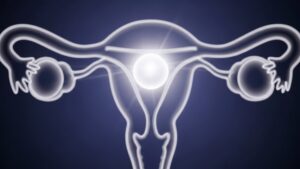
The cells of the endometrium change their properties, blood flow is adjusted, and conditions are created under which an embryo can attach. However, there is only a limited time window during which the uterus is particularly receptive to an embryo. This is referred to as the “implantation window.”
This means: Even an embryo with good developmental potential requires a uterine lining that sends the appropriate signals at the right time. Timing is therefore crucial.
The Embryo is Not Simply Passive
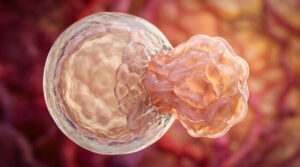
The embryo also plays an active role in this process. As soon as the early blastocyst approaches the uterine lining, a complex exchange of signaling molecules begins.
Among other things, hormones, growth factors, cytokines, and so-called extracellular vesicles are being studied. These tiny particles can transmit biological information between cells and may help the maternal tissue and the embryo adapt to one another. Of particular interest is the pregnancy hormone hCG (human chorionic gonadotropin), which is produced very early on by the developing embryonic tissue.
In simple terms, this process can be thought of as a form of biological communication: The uterus alters its environment, while the embryo sends out signals. Only when both systems are compatible can the next phase begin.
The Uterine Lining is More than Just a Passive Surface
Research is increasingly showing that the endometrium has the ability to respond very precisely to its environment. During the menstrual cycle, the cells of the endometrium alter their gene activity and produce different molecules.
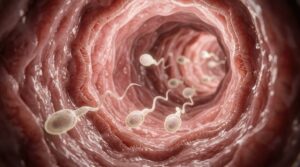
These include, for example, certain adhesion molecules, growth factors, and signaling molecules that can influence how the embryo comes into contact with the endometrium. Modern investigative methods now enable researchers to study these changes at the molecular level and determine which genes and signaling pathways are particularly active during implantation.
This provides a much more nuanced picture of implantation. The uterus is not simply “ready or not ready.” Its cells change dynamically and respond to hormonal and possibly also embryonic signals.
The Immune System Plays a Surprisingly Important Role
The involvement of the immune system is particularly fascinating. At first glance, one might expect the immune system to recognize the embryo as foreign and attack it. After all, the embryo also carries the father’s genetic material and is therefore not completely immunologically identical to the mother.
In fact, the immune system in the uterus undergoes significant changes during the implantation period. Certain immune cells, including so-called uterine natural killer cells, regulatory T cells, and macrophages, take on specific roles. Among other things, they help support implantation while simultaneously preventing an excessive immune response against the embryonic tissue.
So the immune system is not simply “turned off” during pregnancy. Rather, it is regulated very precisely, both locally and over time. The uterus must simultaneously provide protection against pathogens and create an environment in which the embryo can develop.
Why Implantation Sometimes Fails
Implantation is a delicately balanced process. If the embryo fails to implant, there can be various causes. The embryo’s developmental potential, particularly its chromosomal makeup, plays an important role. However, the uterine lining and its hormonal, immunological, and molecular environment can also have an impact.
For example, if endometrial receptivity is impaired, the precise timing of interaction between the embryo and the uterus may be disrupted. Diseases or changes in the uterus can also affect the conditions necessary for implantation.
It is important to note that not every failed implantation means that the uterus has “rejected” the embryo. Implantation depends on many factors, and the relative importance of embryo quality and the endometrium remains a subject of ongoing scientific research. Especially in fertility treatments, it is therefore too simplistic to blame a single factor for a failed implantation.
What Happens After Initial Contact?
If conditions are right, the embryo begins to bind more and more closely to the uterine lining. Cells of the so-called trophoblast—which later develop into, among other things, essential components of the placenta—penetrate the uterine lining.
In the process, the uterine tissue undergoes further changes. The stromal cells of the endometrium undergo a process known as decidualization and are prepared for pregnancy. At the same time, the local immune environment changes, and the supply of nutrients to the developing embryo is progressively established.
Thus, within a short time, what begins as a tiny cluster of cells develops into an increasingly close biological connection between the future child and the maternal tissue.
A Fascinating Interplay Rather than a Simple “Selection”
The idea that the uterus simply decides whether to “accept” or “reject” an embryo is therefore somewhat oversimplified. Rather, it involves a constant dialogue between the embryo and the uterine lining.
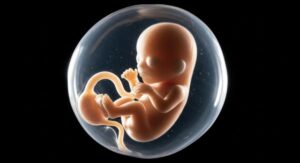
Recent research even describes the endometrium as a kind of biological sensor that responds to signals from the embryo and to changes in its own environment. At the same time, the embryo influences its environment through various signaling molecules. However, it is not yet fully understood exactly how the quality of an embryo is recognized in this process and which signals are crucial for successful implantation.
This is precisely why implantation is of great importance in fertility medicine. Despite modern methods of assisted reproduction, it can happen that a viable embryo fails to implant. Researchers are therefore increasingly seeking not only to examine the embryo itself but also to better understand the molecular environment of the uterus.
Researchers Are Searching for Early Signals
Modern “multi-omics” techniques make it possible to examine the endometrium much more precisely than in the past. Researchers analyze, among other things, gene activity, proteins, and metabolites to determine which changes are associated with a receptive endometrium.
The long-term goal is to better understand why implantation occurs without difficulty in some women, while it repeatedly fails in others. This could one day lead to more targeted methods for assessing the conditions for an embryo transfer during fertility treatment on a more individualized basis.
However, many of these approaches are still under investigation. Not every test for so-called “uterine receptivity” currently available has a clearly demonstrated benefit in terms of the likelihood of a successful pregnancy. Therefore, it is important to distinguish between scientifically interesting biomarkers and clinically proven treatment methods.
When the Embryo Actually “Knocks”
The first days of pregnancy are thus among the most fascinating phases of human development. A tiny embryo encounters a uterine lining that has prepared itself hormonally and, at the same time, is reorganizing its immune system. Both sides exchange signals, alter their environment, and must synchronize within a very limited time window.
Research is showing more and more clearly that a successful pregnancy depends not only on the presence of an embryo, but also on how well the embryo and the uterus communicate with each other. Implantation is not a passive attachment but a highly complex biological dialogue.
And it is precisely this dialogue that could become even more important for fertility medicine in the future: The better scientists understand which signals an embryo sends out, how the uterus responds to them, and why this communication is sometimes disrupted, the more precisely they may be able to investigate and treat the causes of failed implantation.
You may also be interested in...
-

For decades, IVF has helped millions of couples undergoing infertility in conceiving a child. Although…
-
A team from Kumamoto University has discovered a new mechanism that could revolutionize infertility treatment…
-
Embryo donation is a growing trend in the adoption field. There are some who know…