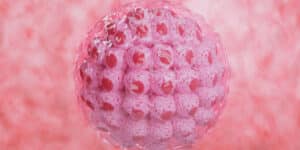
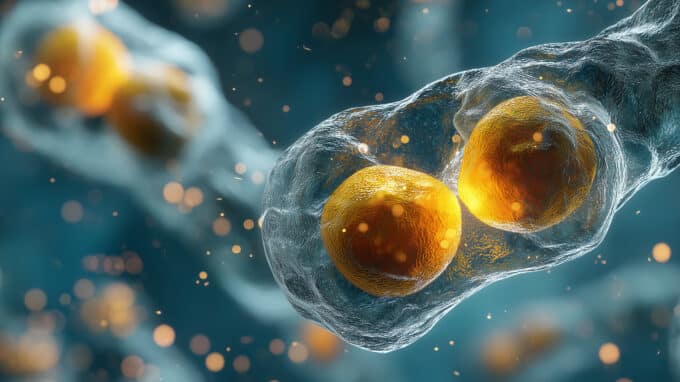
After fertilization, an astonishingly complex process begins: within a few days, a single cell develops into a tiny cluster of cells that can eventually implant itself in the uterus as a blastocyst. In the process, the early embryo goes through several stages of development. Not every fertilized egg reaches the blastocyst stage. But what actually happens during these first five days? And why do some embryos continue to develop, while others stop dividing even before that?
Day 0: An Egg and a Sperm Cell Form a Zygote
Development begins with fertilization. During this process, the egg and sperm fuse together. The genetic information from both parents is combined.
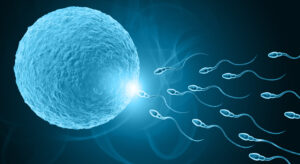
Initially, the genetic information from the egg and sperm remains separate. It is located in what are called pronuclei. The chromosome sets are then combined. A new cell is formed: the zygote. It already contains the genetic foundation for further development. Although the zygote initially consists of only a single cell, a highly regulated developmental process begins shortly after fertilization.
Day 1: The First Cell Divisions Begin
The zygote does not simply grow into a larger cell during this early phase. Instead, it divides. One cell initially becomes two, then four, and later an ever-increasing number of cells. These early cells are called blastomeres.
It is noteworthy that the embryo hardly grows in size at all during these so-called cleavage divisions. Rather, the original cell is divided into increasingly smaller cells. Meanwhile, the early embryo moves through the fallopian tube toward the uterus.
Days 2 and 3: More and More Cells are Formed
With each subsequent division, the number of cells increases. Two become four, then about eight, and eventually even more. The embryo now consists of a small cluster of cells. At the same time, the organization of these cells changes.
The individual cells begin to interact more closely with one another. This process is called compaction. As a result, the cells—which were initially arranged rather loosely—gradually form a compact structure.
During this phase, the embryo also gradually takes control of the activity of its own genes. While the very earliest stages of development are still heavily influenced by molecules that were already present in the egg cell, the embryo’s own genome is now becoming increasingly active.
Day 4: The Morula Develops Into a More Complex Structure
After several cell divisions, the so-called morula forms. The name is derived from the Latin word for mulberry, because the cell structure resembles one under a microscope. The cells now begin to specialize more.
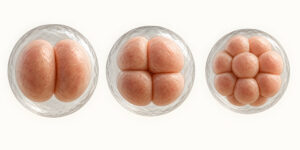
Some cells are located more toward the center of the cell mass, while others increasingly form the outer layer. This lays the foundation for the later differentiation of various cell types. A fluid-filled cavity eventually forms inside. As a result, the cluster of cells develops from a compact morula into a blastocyst.
Day 5: The Blastocyst Forms
Around the fifth day of development, the embryo reaches the blastocyst stage under normal conditions. The blastocyst is no longer a simple cluster of cells. It consists of different regions that will later perform distinct functions.
An outer layer of cells is called the trophectoderm. Among other things, important structures of the placenta will later develop from it. Inside is the inner cell mass. The actual embryo develops from this mass.
Between them lies a fluid-filled cavity. Thus, within just a few days, the embryo has undergone a crucial developmental step: a single fertilized egg has become a complexly organized blastocyst.
Why Don’t All Embryos Reach the Blastocyst Stage?
One important point is often overlooked: Not every fertilized egg develops into a blastocyst. Developmental processes can come to a halt as early as the first cell divisions. There are various possible causes for this.
Changes in chromosome number play an important role. During cell division, the chromosomes must be correctly distributed among the resulting daughter cells. Errors in this process can result in individual cells having an incorrect number of chromosomes.
Such changes are referred to as aneuploidies. Chromosomal abnormalities can impair the further development of an embryo. However, they are not the only possible reason why an embryo fails to continue developing.
The complex molecular processes necessary for cell division, metabolism, and the activation of certain genes must also interact precisely. For this reason, early embryonic development is a process involving many biological control mechanisms.
What Does Mosaicism Mean in Embryos?
It becomes particularly interesting when not all cells of an embryo are genetically identical. In a mosaic embryo, different cell groups have different chromosome sets. For example, some cells may have a normal number of chromosomes, while other cells may have a chromosomal abnormality.
Such differences can arise from errors during cell division after fertilization. This also means that an embryo cannot always be genetically described simply as “normal” or “abnormal.” There may be different cell lines within the same embryo.
When examining embryos as part of fertility treatment, a distinction is therefore made between euploid, aneuploid, and mosaic findings, among others.
How Do Such Differences Arise?
During each cell division, the genetic material must first be copied and then correctly distributed between the two new cells. This process is organized with extreme precision. Nevertheless, errors can occur.
If an error occurs during the very first cell divisions, it can be passed on to subsequent cells. As a result, a group of cells may develop with a specific chromosomal abnormality later on, while other cells do not exhibit this abnormality. Depending on when and how such an error occurs, the pattern in the later embryo may vary.
Why is Early Development so Fascinating?
The first five days after fertilization are among the most dynamic phases of human development. Several fundamental changes occur in a very short time:
- A single cell begins to divide repeatedly.
- The number of cells increases rapidly.
- The cells change their arrangement and begin to specialize.
- The embryonic genome increasingly takes control of development.
- A morula forms.
- Eventually, a blastocyst develops with distinct cell regions.
At the same time, a kind of natural biological selection takes place: Not every fertilized egg continues to develop.
From the Blastocyst to Implantation
However, early development is not yet complete at the blastocyst stage. Once this stage is reached, the embryo must break free from its protective shell, the zona pellucida. This process is called “hatching.” The blastocyst can then make contact with the uterine lining and begin implantation.
This marks the beginning of another crucial phase of early pregnancy. However, early development is not yet complete at the blastocyst stage. After reaching this stage, the embryo must break free from its protective shell, the zona pellucida. This process is called “hatching.” The blastocyst can then make contact with the uterine lining and begin implantation. This marks the beginning of another crucial phase of early pregnancy.
The First Five Days at a Glance
| Development Phase | What Happens? |
|---|---|
| Day 0 | Fertilization and formation of the zygote |
| Day 1 | cell divisions |
| Day 2–3 | Further divisions and increasing compaction |
| Day 4 | Development into a morula |
| Day 5 | Formation of the blastocyst |
| Afterward | Hatching and preparation for implantation |
Conclusion
Only a few days pass from fertilization to the blastocyst stage—and yet the embryo undergoes fundamental changes during this brief period. Through repeated divisions, a single cell develops into a complex, organized cluster of cells. At the same time, numerous processes must interact precisely. Errors in cell division or chromosome distribution can prevent further development or lead to the formation of different cell lines.
The blastocyst represents an important milestone in this process. It is the result of rapid development that begins immediately after fertilization—and forms the basis for subsequent implantation and further embryonic development.
You may also be interested in...
-

Research conducted by doctoral student Bohan Chen in the laboratory of Idse Heemskerk at the…
-
A new discovery by researchers at the RIKEN Center for Biosystems Dynamics Research (BDR) in…
-
More couples than ever are turning to in vitro fertilization to conceive. If you don't…