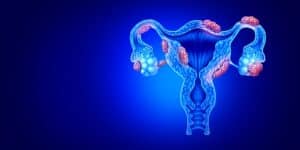
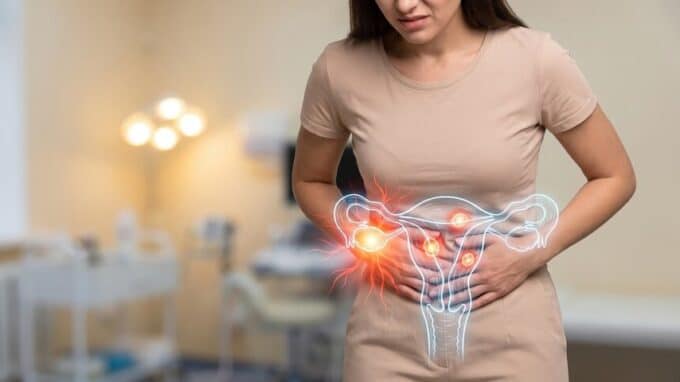
Endometriosis can cause severe pain and make it difficult to conceive. A new study now offers hope for a potential therapeutic approach: Using a special technology, researchers have modified the active ingredient niclosamide so that it can specifically target certain immune cells in endometriosis lesions. In experiments with mice, the pathological tissue lesions regressed, and at the same time, pain-related measurements improved. However, it remains to be seen whether this can lead to a new treatment for women with endometriosis who are struggling to conceive.
Why a Tapeworm Medication Might Help with Endometriosis
If a pregnancy does not occur despite trying to conceive, endometriosis may be a possible cause. In this chronic condition, tissue similar to the uterine lining grows outside the uterus—for example, on the ovaries, the peritoneum, or around other pelvic organs. The condition can cause inflammation, severe menstrual pain, and pain during sexual intercourse. For some affected individuals, it also impairs fertility. Treatment is often a challenge. Hormonal therapies can alleviate symptoms but generally prevent pregnancy while they are being used. Surgical procedures can remove endometriotic lesions, but the condition may recur. Furthermore, when performing surgery on the ovaries, it is essential to carefully consider how the procedure might affect the egg reserve.

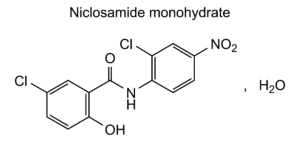
For this reason, researchers are seeking new ways to treat these pathological changes more precisely. One approach is now receiving particular attention: a specially formulated niclosamide, which was originally used as a medication against parasitic infections. Niclosamide is an active ingredient that has long been used to treat certain tapeworm infections. However, research has shown that the substance can also influence biological signaling pathways involved in inflammation and cell growth. This piqued the interest of scientists searching for new treatment options for endometriosis. This is because it is not only the tissue lesions themselves that play a role in the disease; the immune system and the inflammatory environment within the affected tissue can also contribute to the persistence of these changes and the resulting symptoms.
An earlier animal study from 2016 already provided evidence that niclosamide can reduce the growth of experimentally induced endometriosis lesions in mice. The researchers observed changes in inflammatory signaling pathways. In a separate experiment, treated mice were able to become pregnant and give birth to offspring. These results provided initial evidence that the active ingredient could potentially be used in an experimental model without fundamentally impairing reproductive function. However, they do not prove either the safety or the efficacy of such a treatment in humans.
One problem remained, however: Niclosamide is poorly soluble in water and is absorbed by the body only to a limited extent. Long-term use could therefore be difficult. Especially for a chronic condition such as endometriosis, it would be important to develop a treatment that is as effective as possible while also being well tolerated. The current research addresses precisely this issue.
New Technology Aims to Deliver the Active Ingredient Specifically to the Affected Immune Cells
For the new study, researchers at Washington State University and the University of Michigan developed a special form of the active ingredient. They combined niclosamide with a so-called dendrimer, a branched molecule that can serve as a delivery system. In addition, they used components designed to promote the uptake of the active ingredient by specific immune cells. The focus was on so-called macrophages. These immune cells normally perform important tasks in defending against pathogens, clearing cellular debris, and regulating inflammation.
In endometriosis, however, certain macrophages can contribute to the development and maintenance of pathological tissue foci. The researchers concentrated on cells that express the folate receptor beta (FRβ). These receptors offer a potential entry point for delivering the active ingredient specifically to the affected cells. The idea behind this is that, rather than distributing the active ingredient as widely as possible throughout the body, it should be directed primarily to where it is needed. This could concentrate the effect on the diseased tissue and limit the burden on other organs.
According to the research team, the specially developed formulation improved the drug’s water solubility and enabled controlled release within the target cells. The experiments also showed that the delivery system preferentially accumulated in the endometriosis lesions under investigation. Significant accumulation in other organs was observed only to a limited extent. This is an important technical step. However, it remains to be seen whether this targeted distribution can also be achieved in humans and whether it actually leads to fewer side effects.
Fewer Endometriosis Lesions and Reduced Pain Sensitivity in Mice
The team then investigated the effect of the new drug formulation in a mouse model for endometriosis. The results were published in 2026 in the journal Advanced Healthcare Materials. The animals received a single injection of the developed drug carrier containing niclosamide. In subsequent analyses, the researchers found that the number and volume of endometriosis lesions decreased significantly. At the same time, the number of FRβ-positive macrophages present at the affected sites decreased.

Improvements were also observed in pain-related measurements. The treated mice were less sensitive to painful stimuli associated with the experimentally induced endometriosis. The effects were still detectable two weeks after treatment. The results are particularly interesting because they address two central issues of the disease: the growth of pathological tissue lesions and the associated pain.
The researchers see this as an indication that specifically targeted immune cells could be a potential starting point for future endometriosis treatments. The study thus provides more than just a hint of the drug’s anti-inflammatory effect. It demonstrates in an animal model that targeted drug delivery can influence both tissue changes and pain-related measurements. Nevertheless, it must be taken into account that a mouse model only partially replicates the complex nature of the disease in humans. The observed improvements therefore cannot be directly extrapolated to women with endometriosis.
What Does this Discovery Mean for Women Trying to Conceive?
This approach is particularly interesting for women who have both endometriosis and difficulty conceiving. The condition can impair fertility in various ways. Inflammatory processes can alter the pelvic environment, adhesions can impair the mobility of the fallopian tubes, and endometriosis on the ovaries can be associated with a reduced egg reserve. Which mechanisms are decisive in each individual case depends, among other things, on the location and severity of the condition. Not every woman with endometriosis has difficulty getting pregnant. Conversely, the disease can also be associated with significant symptoms or fertility problems even when there are relatively few visible lesions.
Targeted treatment of the pathological tissue lesions could potentially help reduce certain symptoms in the future. However, based on the results to date, it remains unclear whether such treatment also increases the chances of a natural pregnancy. The current study primarily examined the development of endometriosis lesions and pain-related responses in mice. It does not prove that more eggs can be retrieved, that egg quality improves, or that the likelihood of pregnancy increases. This distinction is particularly important for women who wish to have children. A treatment that alleviates pain or reduces the size of endometriosis lesions does not automatically improve fertility. To assess this, targeted studies on reproductive function and, later, clinical trials involving women would be necessary.
Could Niclosamide Become an Alternative to Hormone Therapies?
One potential advantage of the new approach is that it does not primarily aim to suppress the menstrual cycle through hormonal means. Many established drug treatments for endometriosis work by altering hormonal regulation. During treatment, pregnancy is often not possible or not intended. A non-hormonal therapeutic approach could therefore represent an interesting long-term complement. It would be particularly relevant for women who wish to treat their symptoms without using hormonal therapy.
However, it would be premature to already describe niclosamide as an alternative to existing treatment options. The new formulation has so far been studied in preclinical trials. There is a lack of clinical studies demonstrating its safety and efficacy in women, the appropriate dosage, and potential side effects. The question of whether such a treatment could be safely used while a woman is actively trying to conceive also remains unresolved. To address this, it would be necessary to investigate, in particular, whether the active ingredient or its delivery system affects egg maturation, fertilization, implantation, or early embryonic development. Until such data are available, the modified niclosamide should be considered an experimental research approach—not an available treatment for endometriosis.
A New Research Path – But Not Yet a Treatment for Those Trying to Conceive
Before these promising results can be turned into a treatment for patients, several additional research steps are necessary. First, it must be determined whether the targeted drug delivery system also proves safe and reliable in larger preclinical studies. In doing so, it is important to consider not only the short-term effects but also potential long-term consequences and the distribution of the active ingredient in the body. Subsequently, clinical trials must demonstrate whether the results can be applied to humans. This raises fundamental questions: Do the endometriosis lesions actually shrink? Can pain be permanently alleviated? What side effects occur? And do certain groups of patients benefit more than others?
For women hoping to conceive, it would also be crucial to determine whether the treatment affects the probability of pregnancy and whether it is suitable for use prior to planned conception. Only once these questions have been adequately answered can we assess what role this approach might play in the future treatment of endometriosis. The new study shows that targeted treatment of certain immune cells could be a potential way to influence endometriosis lesions and the associated pain. In a mouse model, the modified niclosamide compound reduced both the number and volume of lesions as well as pain-related responses.
This is a promising result for further research. However, it does not mean that women with endometriosis will simply be able to take an existing tapeworm medication in the future. The new formulation differs from the conventional active ingredient, and its safety in humans must first be tested. For women hoping to conceive, it therefore remains crucial to coordinate treatment individually with specialized physicians. Depending on age, symptoms, the location of the endometriosis lesions, and how long they have been trying to conceive, different approaches may be appropriate.
You may also be interested in...
-

Endometriosis is one of the most common gynecological diseases. According to the World Health Organization,…
-
There are a number of different diseases that attack women, finding a way to use…
-
Endometriosis is a disorder in which cells resembling the endometrium, the tissue that lines the…