

When a pregnancy is slow in coming, many women eventually wonder whether there is a problem with their fallopian tubes. Even if their menstrual cycle is regular and ovulation is occurring, blocked or narrowed fallopian tubes can make it difficult to become pregnant. But when should you have your fallopian tubes checked? What does such an examination involve? And does a blocked fallopian tube automatically mean that a natural pregnancy isn’t possible? In this article, we explain the functions of the fallopian tubes, when an examination might be advisable, and what options are available for checking their patency.
1. Why are the Fallopian Tubes so Important for Pregnancy?
The fallopian tubes connect the ovaries to the uterus. After ovulation, the egg is picked up by the fallopian tube. This is also where fertilization by a sperm cell normally takes place. The fertilized egg is then transported toward the uterus. For this process to work, the fallopian tubes must be open and able to perform their transport function. If one or both fallopian tubes are blocked or damaged, this can reduce the chances of pregnancy. Sometimes these changes occur without the woman experiencing any noticeable symptoms.

Possible causes include, for example:
- Previous inflammation in the pelvic area, such as from certain sexually transmitted infections.
- Endometriosis, which can cause inflammation or adhesions.
- Previous surgeries in the abdominal or pelvic area.
- A previous ectopic pregnancy.
- Scarring or adhesions in the area of the fallopian tubes.
It’s important to note: Not every woman with these risk factors actually has blocked fallopian tubes. Whether an examination is advisable depends on the individual’s medical history and the overall situation regarding her desire to have children.
2. When Should You Have Your Fallopian Tube Patency Checked?
An examination is primarily considered as part of the evaluation of infertility. It can help identify possible causes and better plan the next steps. It may be particularly advisable to have the fallopian tubes examined more closely if:
Pregnancy does not occur despite trying to conceive
With regular unprotected sexual intercourse, a medical evaluation is usually recommended after twelve months. For women aged 35 and older, it is often advised as early as six months. If there are known risk factors or other abnormalities, an earlier evaluation may be advisable.
There is a history of pelvic inflammatory disease
Certain infections can damage the fallopian tubes, even if they caused only minor symptoms at the time.
Endometriosis is suspected or has been diagnosed

Endometriosis can be associated with adhesions and changes in the pelvic area. Whether and which tests are appropriate depends, among other things, on the severity of the condition and the symptoms.
An ectopic pregnancy has already occurred
After an ectopic pregnancy, a targeted evaluation of the fallopian tubes may be important when planning future pregnancy attempts.
If fertility treatment is planned
Before insemination, it is important that at least one suitable fallopian tube is patent. In the case of planned in vitro fertilization (IVF), the situation is assessed differently; however, certain changes in the fallopian tubes can also play a role in this context.
The examination should not be performed automatically on every woman. Doctors decide, based on medical history, additional findings, and the planned treatment, whether it is a sensible next step.
3. What Types of Examinations are Available?
Various procedures are available. They differ in how they are performed, the information they provide, and the level of discomfort involved.
HyCoSy: Fallopian Tube Examination with Ultrasound
The HyCoSy is an ultrasound examination using a contrast agent. The abbreviation stands for hysterosalpingographic contrast sonography. During the procedure, a thin catheter is carefully inserted through the cervix into the uterus. A fluid or a special contrast agent is then introduced, and its path can be observed via ultrasound. If the contrast agent flows through the fallopian tubes and becomes visible in the abdominal cavity, this indicates that they are patent.
What are the advantages of HyCoSy?
- It does not require X-ray radiation.
- It can usually be performed on an outpatient basis.
- Anesthesia is generally not required.
- In addition, the uterine cavity can be assessed.
The procedure may be uncomfortable. Some women feel only a slight pulling sensation, while others experience stronger, menstrual-like cramps. Pain tolerance varies from person to person.
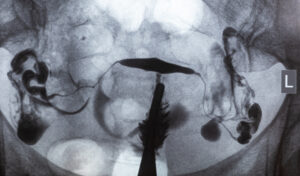
HSG: Fallopian Tube Examination With X-rays and Contrast Medium
Hysterosalpingography, or HSG for short, is an X-ray procedure in which contrast medium is injected through the cervix into the uterus and the fallopian tubes. The X-ray images allow for an assessment of whether the contrast dye passes through the fallopian tubes into the abdominal cavity. HSG is a well-established procedure for examining the uterine cavity and the fallopian tubes. Unlike HyCoSy, this procedure uses X-rays. Which method is more appropriate depends on the medical issue, the procedures available locally, and the individual’s situation.
Laparoscopy With Dye Test
Another option is laparoscopy, also known as laparoscopy. In this procedure, a camera is typically inserted into the abdominal cavity under anesthesia. At the same time, a dye can be introduced through the uterus to observe whether it exits through the fallopian tubes. This procedure is more invasive than HyCoSy or HSG. However, it can provide additional information, such as regarding adhesions or endometriosis.
For this reason, a laparoscopy is not normally a routine initial examination performed solely to check fallopian tube patency. It may be appropriate if additional findings or symptoms warrant surgical evaluation.
4. When in the Menstrual Cycle is the Examination Performed?
The examination is usually scheduled after menstruation and before ovulation. During this time, it is easier to rule out a possible early pregnancy, and conditions for the examination are often favorable. The exact date depends on your cycle, the method used, and the guidelines of your healthcare provider’s office.
Before the examination, it is determined whether pregnancy can be ruled out and whether there are signs of an acute infection. If an active infection is present, the examination must generally be postponed. It’s best to discuss with your gynecologist’s office on which day of your cycle the exam should take place and whether you need to do anything to prepare.
5. Does the exam hurt?
This is a question that concerns many women before they schedule an appointment. And that’s understandable. During the exam, the catheter and the introduction of the fluid can cause abdominal cramps that feel similar to menstrual cramps. The severity of these cramps varies from person to person. Some women find the exam quite tolerable, while others find it distinctly uncomfortable. Therefore, it would be incorrect to make a blanket promise that it is pain-free.
Before your appointment, talk openly about potential pain and ask about appropriate pain relief measures. If you experience severe discomfort during the exam, you should inform the medical team immediately. After the exam, you may experience temporary mild cramping and light spotting. If you have a fever, severe or worsening pain, foul-smelling discharge, or a significant deterioration in your condition, you should seek medical help promptly.
6. What does it mean if a fallopian Tube is Blocked?
An abnormal finding does not automatically mean that pregnancy is impossible. Key factors include whether one or both fallopian tubes are affected, the location of any potential blockage, and whether other fertility factors are present. If only one fallopian tube is blocked, a natural pregnancy may still be possible, provided the other fallopian tube is functioning adequately and there are no other relevant limitations.
If both fallopian tubes appear blocked, a natural pregnancy is significantly more difficult. In such cases, further testing and, if necessary, fertility treatment may be considered. However, an abnormal test result does not always indicate a definite blockage. For example, temporary muscle spasms at the entrance to the fallopian tube can influence the assessment. Depending on the findings, further evaluation may therefore be advisable.
The available options depend on the exact findings and the overall situation. In certain cases, further tests or surgical procedures may be considered. With IVF, eggs are fertilized outside the body, so fertilization does not have to take place in the fallopian tube. An abnormal finding should therefore always be discussed on an individual basis before any treatment decisions are made.
7. Does a Normal Fallopian Tube Test Mean I Can Get Pregnant?
Normal test results are helpful information, but they are no guarantee of pregnancy. The test primarily shows whether the contrast dye used was able to flow through the fallopian tubes at the time of the examination. It cannot assess all aspects of fertility.

Other factors also play a role, including:
- Ovulation and hormonal regulation.
- The egg reserve and age.
- Sperm quality.
- The uterus and its lining.
- The function of the fallopian tubes, which goes beyond mere patency.
For this reason, the fallopian tube test is combined with additional tests as needed. These may include, for example, a menstrual cycle and hormone evaluation, an ultrasound, and a semen analysis. Comprehensive fertility testing takes both partners into account whenever possible and avoids focusing the evaluation exclusively on the woman.
8. What Happens After the Examination?
After the examination, the results are discussed with the treating physician. If the fallopian tubes are patent, an attempt can first be made—depending on the other findings—to conceive naturally.
If abnormalities are found, the doctor will assess whether further testing or treatment is advisable. Factors such as age, how long you’ve been trying to conceive, any underlying medical conditions, and the results of additional tests all play a role in this decision. So you don’t need to know which path is right for you before your appointment. The examination is designed to help you better understand your situation and make an informed decision.
Conclusion: When is it Worth Having Your Fallopian Tubes Examined?
Testing fallopian tube patency can be an important part of fertility testing—especially if pregnancy has not occurred for a long time or if there are risk factors for changes in the fallopian tubes. Procedures such as HyCoSy or HSG can be used to assess whether the contrast agent passes through the fallopian tubes. Laparoscopy is primarily considered when additional issues need to be clarified.
An abnormal finding does not automatically mean that there is no possibility of becoming pregnant. At the same time, a normal finding cannot rule out other causes of infertility. A consultation with your gynecologist’s office or a fertility clinic can help determine which tests are actually appropriate for your situation.
Frequently Asked Questions About Fallopian Tube Patency
Is it possible to get pregnant despite having a blocked fallopian tube?
Yes, a natural pregnancy may be possible if the other fallopian tube is functioning properly and there are no other significant fertility issues.
Can blocked fallopian tubes be detected with a standard ultrasound?

A routine gynecological ultrasound can reveal certain abnormalities, but it generally cannot reliably assess fallopian tube patency. Specialized procedures are used for this purpose.
Does every woman trying to conceive need to have her fallopian tubes examined?
No. Whether the examination is advisable depends, among other things, on how long the couple has been trying to conceive, their age, medical history, and potential risk factors.
Is HyCoSy better than HSG?
No single method is superior in every situation. HyCoSy does not involve X-ray radiation. The appropriate examination should be determined based on the individual’s specific situation.
Can the examination improve fertility?
The test is primarily diagnostic. In certain procedures, the introduction of fluid may potentially dislodge small mucus plugs. However, this does not mean that the test generally improves fertility or guarantees pregnancy.
You may also be interested in...
-

There are many possible causes of infertility. Fallopian tube abnormalities are among them, but there…
-
This article is about a condition called hydrosalpinx and how it may be caused or…
-
New research supports fallopian tube flushing as a viable means to treat infertility that is…


