
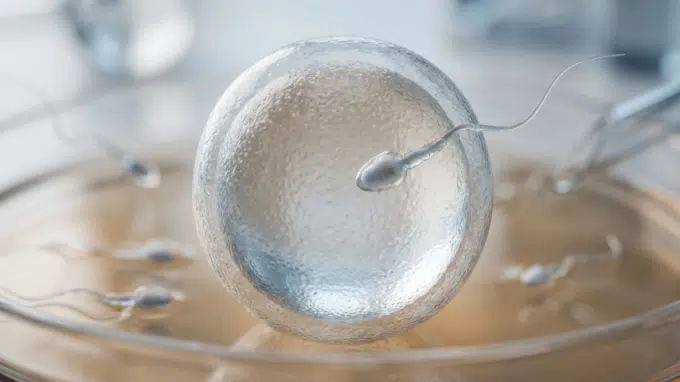
During fertility treatment, sperm spend part of their time outside the male body. They are processed, examined, and prepared for fertilization under controlled conditions. But could this artificial environment also alter their epigenetic properties? A new study in Human Reproduction Open investigated this question. The results provide tentative evidence that DNA methylation in mature sperm remains remarkably stable.
Why the Epigenetic Information of Sperm Is Important
During natural fertilization, sperm travel a long distance through the female reproductive tract. In artificial insemination, the process is different: The sperm are processed in the laboratory and then used for further treatment. In the process, they come into contact with various nutrient and culture media. These are intended to create the most favorable conditions possible so that the sperm retain their function. However, the laboratory environment differs significantly from the natural conditions in the human body.

Researchers have therefore long been investigating whether such external influences affect not only the motility and viability of sperm but also their epigenetic properties. A Danish-French research group has now investigated whether DNA methylation in mature human sperm changes during such laboratory incubation. Sperm not only carry half of a future child’s genetic material; they also carry specific epigenetic information. DNA methylation plays an important role in this process. In this process, small chemical groups are attached to specific sites on the DNA. This can influence how genes are regulated without altering the actual DNA sequence.
During the development of egg and sperm cells, such epigenetic patterns are repeatedly remodeled. However, some of the methylation patterns are preserved and may play a role in the early development of the embryo. In reproductive medicine, therefore, the focus is not only on whether a sperm cell is sufficiently motile and capable of fertilizing an egg. The quality of the transmitted genetic and epigenetic information is also a focus of research. Previous studies have shown that children conceived through assisted reproduction have an increased risk of certain rare diseases associated with epigenetic changes. This raises the question of whether laboratory conditions during treatment might also play a role.
What the Researchers Studied in the Lab
For the study, the team first analyzed sperm samples from four men using a comprehensive protein analysis. A total of 1,930 proteins were identified. Among them were proteins involved in the regulation of epigenetic processes. The scientists then examined sperm samples from 15 healthy men between the ages of 20 and 40. The processed sperm cells were incubated for 24 hours under three different conditions:
- In a standard control medium
- In a medium containing hydrogen peroxide (H₂O₂)
- In a medium containing palmitate, a saturated fatty acid
The latter two conditions were deliberately chosen. Both oxidative stress and certain fatty acids can trigger changes in DNA methylation in other cell types. The researchers wanted to find out whether mature sperm are similarly sensitive or whether their epigenetic patterns are more stable in the face of such influences.
No Changes in DNA Methylation After 24 Hours
The result differed from what might have been expected based on previous findings regarding other cell types. Although the sperm were exposed to different laboratory conditions, the scientists detected no changes in the DNA methylation patterns they examined. This held true for both the normal culture medium and the conditions involving hydrogen peroxide and palmitate.

The epigenetic information of the mature sperm thus proved to be largely stable within the time period studied. The researchers conclude that changes in DNA methylation in response to environmental stressors may be more likely to occur during earlier developmental stages of the sperm. During these phases, the epigenetic patterns are still being established and are apparently more sensitive to external influences. However, this does not mean that all characteristics of the sperm remain unaffected by the laboratory conditions.
Sperm Motility Nevertheless Decreased
This is because a change was indeed observed in another characteristic examined. Sperm motility decreased during the 24-hour incubation under all three conditions. This decline was most rapid in the samples exposed to hydrogen peroxide. This is an important distinction: while the epigenetic DNA patterns remained stable, the functional properties of the sperm cells did indeed change.
Oxidative stress, in particular, is considered a potential stressor for sperm. Reactive oxygen species can attack various cellular components and, among other things, impair motility. The study thus shows that unchanged DNA methylation does not automatically mean that sperm experience no stress whatsoever under laboratory conditions.
What Does this Mean for Artificial Insemination?
For reproductive medicine, the results are initially an interesting finding. They suggest that the DNA methylation of mature human sperm is not readily altered during a 24-hour incubation under the conditions studied. This could mean that certain epigenetic risks discussed in connection with assisted reproductive technologies do not necessarily arise from the direct incubation of mature sperm in the laboratory.
Other developmental phases may play a greater role. These include, in particular, spermatogenesis—the process by which mature sperm are produced from precursor cells in the testicles. Important epigenetic patterns are established during this development. External influences could have different effects during this phase than on sperm that have already matured. However, it is not yet possible to deduce from the current study what significance the results have for the actual success of IVF or ICSI treatments. The researchers did not examine fertilization rates, embryo development, or subsequent pregnancy outcomes.
Why the Results Must Still be Interpreted With Caution
The study provides an interesting insight into the stability of epigenetic information in human sperm. However, its significance is limited by several factors. For one thing, the experiments were conducted using sperm from only 15 healthy men. For another, the scientists examined only three different culture conditions and a time period of 24 hours.

Furthermore, the analytical method used does not cover all regions of the genome. Changes in DNA segments that were not examined cannot therefore be completely ruled out. In addition, the laboratory conditions only simulated certain stress scenarios. Different culture media, longer incubation times, or other influences could very well yield different results. The authors also point out that it cannot be ruled out that certain sperm with different epigenetic characteristics may be preferentially preserved during processing. This would represent a different mechanism than an actual change in DNA methylation within individual sperm.
Another Building Block for the Safety of Fertility Treatments
Research into epigenetic changes in assisted reproductive technologies is still in its infancy. It is well known that early embryonic development depends heavily on precise gene regulation. Therefore, it is important to better understand the potential effects of the laboratory environment on egg and sperm cells.
The current study provides another piece of this puzzle. It shows that mature human sperm can maintain their observed DNA methylation patterns for 24 hours, even under certain experimental stress conditions. For couples trying to conceive, this is an interesting finding, but it should not be interpreted as comprehensive proof of safety for all artificial insemination procedures.
Conclusion: Mature Sperm are More Epigenetically Stable than Expected
The study shows that DNA methylation in mature human sperm remains surprisingly stable under the laboratory conditions tested. Even exposure to hydrogen peroxide or palmitate did not result in any detectable changes in the methylation patterns examined within 24 hours.
At the same time, sperm motility decreased, particularly under oxidative stress. The results thus make it clear that epigenetic stability and the functional quality of sperm are distinct aspects.
This raises a new question for fertility research: If DNA methylation in mature sperm is comparatively stable, certain epigenetic changes could already occur during their development in the testis—long before they even arrive at a fertility clinic.
You may also be interested in...
-

New research has found that the sperm of a crocodile has different properties than scientists…
-
You may have heard of the gut microbiome and its influence on a person's overall…
-
When a couple is trying to conceive, a low sperm count or low sperm mobility…