
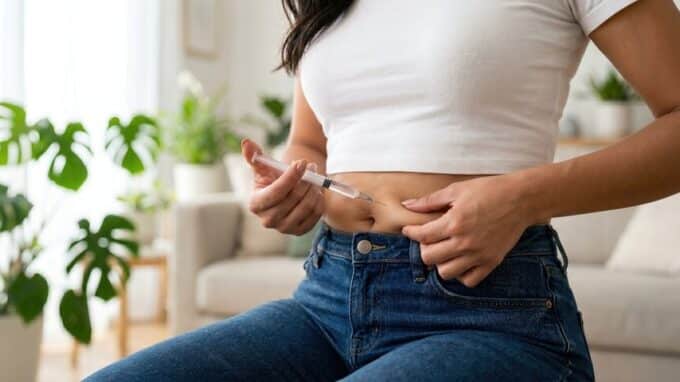
A fertility treatment involving a significantly lower number of hormone injections could be of interest to some women in the future. A new randomized study examined a so-called “two-shot” protocol, in which only two injections of a long-acting FSH medication were required during controlled ovarian stimulation. The study was conducted by a team led by Valeria Donno and Nikolaos Polyzos at Dexeus Fertility Hospital in Barcelona and published in the journal Human Reproduction. A total of 194 women participated in the study.
The researchers’ primary goal was not to reduce the number of injections, but to determine whether the simplified regimen could yield a comparable number of mature eggs as a conventional stimulation protocol.
Why Hormonal Stimulation Has Traditionally Required So Many Injections
In IVF or fertility treatment, the ovaries are stimulated with hormones. The goal is not just to allow a single egg to mature, but to develop multiple follicles simultaneously. Gonadotropins are typically used for this purpose. These hormones support follicle growth and are administered via injection over several days in many stimulation protocols.

For patients, this means more than just numerous injections. The treatment also requires a strict schedule, regular checkups, and precise coordination of medications. The burden of daily injections has therefore long been a topic of discussion in reproductive medicine. A stimulation regimen that is as simple as possible can be particularly attractive when planning egg cryopreservation.
How does the new “Two-Shot” protocol work?
The new study focused on corifollitropin alfa, or CFA for short. This is a long-acting form of the follicle-stimulating hormone (FSH). The key difference from the conventional comparison regimen lay in how the medication was administered.
The women in the new treatment arm received:
- 150 micrograms of corifollitropin alfa on the first day
- an additional 100 micrograms of corifollitropin alfa on the fifth day
Thus, the actual FSH stimulation consisted of two injections. In the control group, however, 150 micrograms of corifollitropin alfa were also administered on the first day. Starting on the eighth day, daily injections of recombinant FSH followed. Both groups additionally received a medication designed to prevent a premature rise in LH. Final maturation of the eggs was subsequently triggered with a GnRH agonist.
Another Phase III study published in 2026 by researchers at the Sixth Affiliated Hospital of Sun Yat-sen University in Guangzhou, China, examined corifollitropin alfa N02 in 474 women with normal ovarian reserve. In this study, one group received a single injection of the long-acting FSH analog for the first week of stimulation, while the control group received recombinant FSH daily. Starting on day 8, treatment continued on an individualized basis in both groups. The result: The group receiving the long-acting formulation yielded an average of 12.1 retrieved oocytes, compared to 10.9 in the daily FSH group. The pre-specified criterion for non-inferiority was met.
The Current Study
The most important question addressed by the current study conducted by researchers at the Hospital in Barcelona was: Can the two-injection regimen yield a comparable number of mature oocytes as conventional treatment? The scientists considered the number of oocytes that had reached the so-called MII stage to be the decisive metric.
This is the stage of maturity at which oocytes are suitable for fertilization. When planning egg preservation, therefore, it is not only the total number of retrieved eggs that matters, but especially the number of mature eggs.
The study was designed as a randomized controlled Phase III trial and took place at a single university fertility center. A total of 194 women were assigned to the two treatment groups in a 1:1 ratio. The participants were 40 years old or younger and met specific criteria regarding ovarian reserve: the number of antral follicles was less than 20, and the AMH level was 3 ng/ml or less.
It is therefore important to note that the results cannot automatically be generalized to all women seeking to conceive. The study examined a relatively well-defined group of women who underwent elective fertility preservation.
Similar Number of Eggs – But an Important Statistical Caveat
Among the women treated with the two-injection protocol, an average of 6.14 mature MII eggs were retrieved. In the comparison group, the figure was 7.19.

The difference was not statistically significant. At first glance, this sounds as though both procedures worked equally well. But this is precisely where an important aspect of the study lies: The researchers explicitly designed their study to demonstrate that the two-injection procedure is not inferior to the standard method. This criterion was not met statistically. The study therefore cannot currently prove that the new procedure is in fact equivalent.
Why “No Significant Difference” Does Not Automatically Mean Equivalence
This point is particularly important for understanding the study. If two groups show no statistically significant difference, this does not automatically mean that both treatment methods are equally effective. In a so-called non-inferiority study, a maximum allowable difference is predetermined so that the new treatment is still considered sufficiently comparable.
In the current study, the predetermined limit was 1.5 mature MII oocytes. However, the statistical uncertainty of the results was so great that an actual reduction exceeding this limit could not be ruled out.
Therefore, the researchers were unable to confirm the non-inferiority of the two-injection protocol. Although the observed difference was approximately one mature egg, the study was not large enough to conclude with certainty that the treatments were equivalent. There were also hardly any differences in the duration of hormonal stimulation. In the two-injection protocol, stimulation lasted an average of about 10.27 days, while in the comparison group it lasted about 10.19 days.
The number of larger follicles on the day of ovulation induction was also comparable. The advantage of the new approach, therefore, does not lie in the fact that the entire treatment would be significantly shorter. Rather, the key difference lies in the number of FSH injections required during stimulation.
Fewer Injections Could Make Treatment Easier
Such a treatment could still be of interest to patients. Controlled ovarian stimulation can be emotionally and logistically stressful. The medications must be administered at specific times, and ultrasound and blood tests are also required.
A protocol in which the daily FSH injection is replaced by a few long-acting doses could therefore simplify the treatment. However, such an approach must prove effective not only in terms of the number of eggs retrieved. The maturity and quality of the eggs, fertilization, embryonic development, pregnancy, and ultimately the live birth rate are also crucial. The current study does not yet provide sufficient answers specifically on these points.
No Conclusions Yet on Pregnancies and Live Births
This is one of the study’s most significant limitations. The study focused on women who wanted to preserve their fertility as a precautionary measure. For this reason, particular attention was paid to the number of eggs retrieved and matured.

The study does not allow for a reliable conclusion as to whether the two-injection protocol ultimately leads to the same number of embryos, pregnancies, or live births as conventional stimulation. Differences in subsequent embryonic development could also not be reliably assessed in this study. The authors themselves therefore point out that further studies are necessary.
What do the Study’s Findings Mean for Women Hoping to Conceive?
The results are particularly interesting because they demonstrate that a significantly simplified stimulation regimen can, in principle, be evaluated. In this study, the two-injection protocol produced a similar average number of mature eggs as the comparison regimen. At the same time, the statistically predefined equivalence has not yet been demonstrated.
This makes it a promising research approach, but not yet a new standard for fertility treatment. Larger and, if possible, independent studies will need to determine whether the procedure can actually become established. In this context, it would be particularly important to investigate the effects of the two protocols on egg quality, embryo development, pregnancies, and live births.
Fewer Injections, But Still a Complex Treatment
The term “Two-Shot” might give the impression that a complete IVF treatment will consist of only two injections in the future. That is not the case. The new protocol reduces the number of certain FSH injections during ovarian stimulation. However, other medications and treatment steps remain necessary.
Regular ultrasound examinations and hormonal monitoring also remain part of the treatment. In addition, the final maturation of the eggs is triggered by an additional injection. The real progress, therefore, would not be fertility treatment “with only two injections,” but rather a significantly simplified hormonal stimulation regimen with fewer daily injections.
A Potential Step Toward More Patient-Friendly IVF Protocols
The current study shows the direction in which reproductive medicine could evolve: In addition to the question of how many eggs can be retrieved, the burden on patients during treatment is increasingly taking center stage. Long-acting hormones could help reduce the number of necessary injections and make it easier to integrate hormonal stimulation into daily life.

A treatment regimen with fewer daily injections could be particularly appealing to women who wish to freeze their eggs as a precaution. While hormonal stimulation and regular ultrasound and blood tests would still be required, the administration of medication could be significantly simplified.
However, the number of injections alone is not the decisive factor. What matters far more is whether, despite the simplified protocol, enough mature eggs can be retrieved and whether these can later lead to successful pregnancies. Based on the current data, it therefore remains to be seen whether the two-injection protocol actually represents an equivalent alternative to the current standard stimulation protocol.
The study provides an interesting initial indication that FSH stimulation may be significantly simplified. Larger studies must now determine whether the results are confirmed and which patients might benefit most from this approach. Until then, the two-injection protocol remains an interesting research approach and is not yet a new standard in fertility treatment.
You may also be interested in...
-

Stopping fertility treatment can be difficult but necessary in certain situations. You can resume fertility…
-
According to BJOG: An International Journal of Obstetrics and Gynaecology, the ethnicity of women who…
-
A newly developed fertility treatment involving blood plasma could mean the possibility of pregnancy for…