

Fear of pregnancy is a widespread but often taboo subject. It can affect women, couples, and even men—regardless of whether they currently want to have children or not. This fear can lurk quietly in the background or be very present, strongly influencing thoughts, feelings, and actions. It becomes particularly relevant when there is a desire to have children or when conflicting feelings about a possible pregnancy develop. In this context, the question often arises: Can fear affect fertility? The answer is complex, because fertility is not a purely biological process, but the result of an interplay of physical, hormonal, psychological, and social factors.
1. Forms of Pregnancy Fear

Fear of pregnancy is not a uniform phenomenon. It can have many faces:
- Fear of physical changes (weight gain, pain, loss of control)
- Fear of childbirth (tokophobia)
- Fear of health risks for mother or child
- Fear of responsibility and life changes
- Financial or professional worries
- Fear of commitment or loss of identity
- Fears based on previous negative experiences (miscarriage, traumatic birth, difficult childhood)
These fears do not have to be conscious or rational. They often have a subliminal effect and manifest themselves in stress, inner turmoil, ambivalent feelings, or avoidance behavior.
2. Psychological Stress and its Effect on the Body
Anxiety is a form of stress. If it becomes chronic, it permanently activates the body’s stress system (hypothalamic-pituitary-adrenal axis).
Biological Processes Under Stress:
- Release of stress hormones such as cortisol and adrenaline
- Inhibition of hormones that are important for the cycle (e.g., GnRH, LH, FSH)
- Changes in the autonomic nervous system
Possible Consequences for Fertility:
- Irregular cycles
- Delayed or absent ovulation
- Shortened or prolonged cycle phases
- Increased PMS symptoms
- Lower libido
Important: These effects are usually reversible. This means that they often disappear when stress is reduced.
3. Anxiety as an Indirect Factor Influencing Fertility

Research shows that anxiety does not automatically cause infertility. Its influence is usually indirect, but nevertheless significant.
Behavioral Effects
Anxiety can lead to behaviors that make conception more difficult, such as:
- Avoiding sexual intercourse or reduced intimacy
- Excessive control (constant cycle tracking, pressure to perform)
- Unhealthy lifestyle (lack of sleep, irregular eating, substance use)
- Suppressing or avoiding the desire to have children
Psychological Pressure
The inner conflict is particularly problematic:
“I want to get pregnant—but I’m afraid of it.”
This contradiction can cause severe internal stress, which has both psychological and physical effects.
4. The Fear-Stress Cycle
Fear of pregnancy can become part of a self-reinforcing cycle:
- Desire or possibility of pregnancy arises
- Fear of the consequences is activated
- Stress hormones increase
- Body reacts more sensitively or “irregularly”
- Perception of loss of control intensifies the fear
- Even more stress is created
This cycle can undermine confidence in one’s own body and create a feeling of “not functioning properly.”
5. Fear, Fertility, and Medical Fertility Treatment
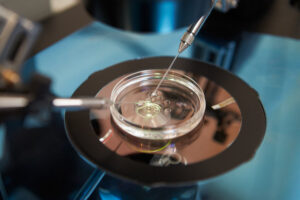
Many people experience intense fears in the context of fertility treatments (e.g., IVF):
- Fear of failure
- Fear of physical side effects
- Fear of renewed disappointment
Studies show that stress and anxiety do not clearly reduce the success rates of medical treatments, but they do influence:
- the emotional experience
- treatment satisfaction
- the likelihood of discontinuing therapy early
Psychological support can play a crucial role here.
6. The Role of Experiences and Influences
Previous experiences have a strong influence on attitudes toward pregnancy:
- Personal childhood experiences
- Relationship with parents
- Traumatic experiences
- Social expectations and pressure to perform
Fear of pregnancy can therefore also be an expression of deeper issues, such as:
- Fear of dependence
- Fear of not meeting expectations
- Fear of making mistakes
These aspects often have a subconscious effect and influence decisions about having children and fertility.
7. What Science Says – Viewed Objectively
In summary, it can be said that:
- There is no clear evidence that fear alone biologically prevents pregnancy.
- Chronic stress can influence hormonal processes and reduce the probability of conception.
- Psychological factors influence behavior, relationships, and self-perception, which in turn are relevant to fertility.
- Fertility is a biopsychosocial process, not a purely mechanical one.
8. Ways of Dealing With Fear of Pregnancy
Taking fears seriously is not a sign of weakness, but of self-awareness.
Possible helpful steps:
- Psychological counseling or psychotherapy
- Education about pregnancy and childbirth
- Stress and emotion regulation (e.g., mindfulness, breathing techniques)
- Open discussions with your partner
- Getting enough sleep to reduce stress and anxiety
- Moderate exercise (not excessive!) to lower cortisol levels and improve hormone balance
- Relief from social pressure (“You have to…”)
You may also be interested in...
-

If you have repeatedly tried and have had no luck in conceiving a child, you…
-
A newly developed fertility treatment involving blood plasma could mean the possibility of pregnancy for…
-
When a couple is trying to conceive and fails multiple times, the experience can cause…