

Ovulation lasts only a few moments, but the development of the follicle in which the egg matures takes many months. During this time, complex biological processes take place in the ovary: cells multiply, metabolic processes change, and hormones regulate the interaction between the egg and its environment. What happens during this process is of central importance to female fertility.
The Development of Egg Cells Begins Even Before Birth
Those hoping to have a child often focus their attention on their fertile days and the timing of ovulation. However, the biological preparation for this moment begins much earlier. The egg cell released during a given cycle has already undergone a long developmental journey. Its growth is closely linked to the surrounding follicular cells, which supply it with nutrients, process hormonal signals, and support its maturation. This process is known as folliculogenesis. It is a finely regulated process that spans several developmental stages and demonstrates just how much biological preparation is necessary before an egg can even be fertilized.
A distinctive feature of female fertility is that egg cells are not formed only after puberty. Their initial development begins while the fetus is still in the womb. In a female fetus, millions of immature germ cells are initially produced. A large portion of these is lost through natural degradation processes even before birth and during childhood. At birth, a girl still has approximately one to two million eggs—or immature eggs—in her follicles. This number continues to decline until the onset of puberty.
The remaining eggs are in a special dormant state. They have already begun meiosis, a specific form of cell division in which the number of chromosomes is later halved. However, this process is initially suspended. Many egg cells remain in this developmental stage for decades until some of them continue to mature over the course of a woman’s reproductive life. This makes the female germ cell reserve fundamentally different from male sperm production, in which new sperm are continuously produced starting at puberty.
Why the Maturation of a Follicle Takes Several Months
The egg cell does not develop in isolation but is surrounded by a shell of specialized cells. Together, they form what is known as the follicle. This serves as a protected developmental space and performs important functions in nourishing and maturing the egg cell. When a dormant primordial follicle is activated, a slow growth process begins. The surrounding cells, which are initially flat, change their shape and multiply. Several layers of cells form, while the egg itself also increases in size.
The individual developmental phases take varying amounts of time. Depending on the scientific model and the specific developmental stage from which calculations are made, the journey from the primordial follicle to ovulation can take several months to nearly a year. Some recent studies suggest shorter time frames for certain stages of follicle development. It is particularly important to distinguish between the long-term growth of a follicle and the final maturation phase, which occurs during a specific menstrual cycle. The follicle that is released during the next ovulation did not, therefore, originate in that cycle.
From the Small Primordial Follicle to the Growing Follicle
At the beginning, the primordial follicle is barely visible. It consists of an immature egg cell surrounded by a single layer of flat supporting cells. When such a follicle is activated, the surrounding cells begin to change. The flat cells gradually transform into cubic granulosa cells. These cells play a vital role in nourishing the egg. They interact closely with the egg and support its growth by providing nutrients, metabolic products, and molecular signals. As development continues, additional cell layers form. The follicle grows larger and develops further specialized structures. These include the so-called theca cells, which later participate in hormone production.
It is noteworthy that these early developmental steps are not controlled solely by the hormones that regulate the monthly cycle. Local growth factors and signaling pathways within the ovary also play a crucial role. The ovary thus possesses a complex regulatory system that influences the development of individual follicles long before they are selected for potential ovulation.
Granulosa Cells: Why the Egg’s Environment Is So Important
During its development, the egg relies on support from its environment. The granulosa cells that immediately surround it are particularly important. They form a network of cellular contacts and signals through which substances are exchanged between the cells. This provides the egg with essential building blocks for its metabolism and allows it to coordinate its development.
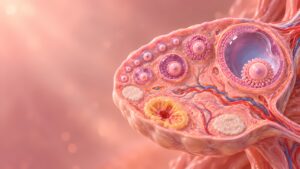
The granulosa cells are also involved in hormone production. Together with the theca cells, they form a functional system that, among other things, enables the production of estrogen. Under the influence of luteinizing hormone (LH), the theca cells produce androgens. These are taken up by the granulosa cells and converted into estrogens with the help of the enzyme aromatase. Aromatase activity is supported in particular by follicle-stimulating hormone (FSH). This interaction is an important component of the hormonal regulation of the female cycle. At the same time, the hormones influence the growth and further development of the follicle.
How the Body Selects the Follicle for Ovulation
During a menstrual cycle, several follicles continue to develop. However, normally only one of them reaches full maturity and becomes the so-called dominant follicle. At the beginning of the follicular phase, the concentration of follicle-stimulating hormone (FSH) rises. This hormone is produced in the pituitary gland and stimulates the growth of the developing follicles.
As development progresses, estrogen production increases. At the same time, the follicles release inhibins, which are also involved in hormonal feedback. This causes the FSH concentration to drop again. The follicle that responds particularly well to the existing hormonal signals is able to continue developing under these conditions. The remaining follicles no longer receive sufficient support and usually undergo a natural process of regression known as atresia. The selection of a dominant follicle is therefore not a random process. It depends on sensitivity to hormones, the developmental capacity of the follicular cells, and various local regulatory mechanisms.
The Final Phase of Maturation: When the Follicle Prepares for Ovulation
Once a dominant follicle has emerged, it continues to grow significantly over the following days. A fluid-filled cavity, known as the antrum, forms inside it. The fluid contains, among other things, hormones, proteins, and other substances that influence the egg’s developmental environment. The follicle grows larger and larger and produces more estrogen. If the estrogen level remains sufficiently high over a certain period of time, the feedback loop between the ovary, pituitary gland, and hypothalamus changes.
Instead of inhibiting the release of LH, estrogen now promotes a pronounced surge in LH. This so-called LH surge triggers the final stages of egg maturation and sets in motion the processes that ultimately lead to ovulation. Shortly before ovulation, the egg resumes its previously interrupted first meiotic division. It then begins the second meiotic division, which is again halted at a certain stage. This process is not fully completed until fertilization occurs. During ovulation, a fully developed egg is not simply expelled from the ovary. In fact, a complex consisting of the egg and the cells surrounding it is released, which can then be taken up by the fallopian tube.
Why Not Every Maturing Follicle Leads to Ovulation
Although several follicles may grow during a cycle, usually only one becomes dominant. The others regress. This process is a natural part of ovarian function and does not mean that there is anything wrong with fertility. The number and quality of available follicles change over the course of a woman’s life. As a woman ages, her ovarian reserve decreases. At the same time, the risk increases that eggs will have chromosomal abnormalities that can impair their ability to develop.
Two aspects must be distinguished here: The ovarian reserve primarily describes how many eggs or follicles are still present. Egg quality, on the other hand, refers to their ability to enable normal fertilization and further embryonic development. Both factors play a role in the desire to have children, but cannot be fully assessed with a single test. Nor do the number of visible follicles or a specific hormone level provide a reliable indication of whether a woman can become pregnant naturally.
What the Long Maturation Period Means for Trying to Conceive
The development of a follicle over several months illustrates that fertility does not depend solely on the events surrounding ovulation. Long before that, processes take place in the ovary that are important for the egg’s subsequent maturation. However, this does not mean that the quality of a specific egg can be specifically improved through a short-term change in diet or the use of individual dietary supplements. While general factors such as a balanced diet, not smoking, and moderate alcohol consumption can support reproductive health, However, there is no reliable evidence that specific measures can improve the quality of a single maturing egg within a few weeks.
The idea that targeted preparation can specifically influence the egg that will be released in a particular cycle is also misguided. Follicle development is regulated by numerous biological factors, many of which cannot be directly influenced. Anyone who does not become pregnant despite regular unprotected sexual intercourse should seek medical evaluation to determine the causes, if necessary. Both female and male fertility can play a role in this.
In general, it can be said that when an egg leaves the ovary during ovulation, it has already undergone a long developmental process. Numerous biological mechanisms are interlinked, ranging from the activation of a dormant follicle through the growth of granulosa cells to the hormonally controlled selection of a dominant follicle. The actual maturation is thus far more than an event occurring over just a few days of the cycle. It is the result of a long-term collaboration between the egg, follicular cells, and the endocrine system—and an important component of female fertility.
You may also be interested in...
-

Ovulation is the most important part of the reproductive process. The following information will explain…
-
-
If you are looking for a natural way to parenthood but having trouble ovulating, there…