
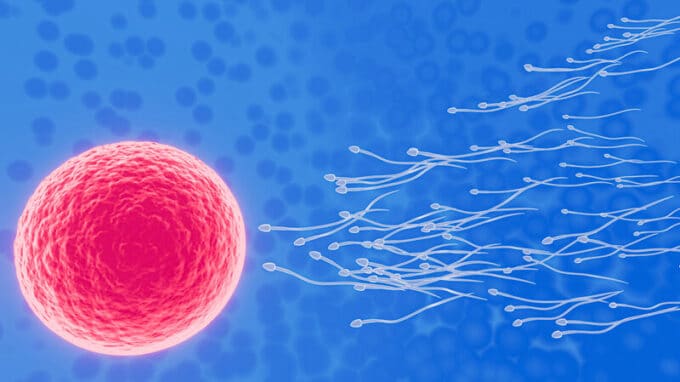
Researchers at Michigan State University have identified a molecular “switch” that increases sperm energy just before they attempt to fertilize an egg. This discovery could improve infertility treatment and support the development of safer, non-hormonal contraceptive methods for men.
On the Trail of the Fuel that Drives Fertilization
“Sperm metabolism is unique in that it is focused solely on generating more energy to achieve a single goal: fertilization,” said Melanie Balbach, assistant professor in the Department of Biochemistry and Molecular Biology and lead author of the study. Before ejaculation, mammalian sperm are in a low-energy state. Once they enter the female reproductive tract, they undergo a rapid transformation. They begin to swim more vigorously and adapt the outer membranes that will eventually interact with the egg. These changes require a sudden and significant increase in energy production. “Many cell types undergo this rapid transition from a low-energy to a high-energy state, and sperm are ideal for studying such metabolic reprogramming,” Balbach said. She joined MSU in 2023 to expand her pioneering work on sperm metabolism.

Early in her career at Weill Cornell Medicine, Balbach helped demonstrate that blocking an important sperm enzyme in mice led to temporary infertility. This discovery highlighted the possibility of a non-hormonal contraceptive method for men. Although scientists knew that sperm cells require large amounts of energy to prepare for fertilization, the exact mechanism behind this increase was previously unclear.
Working with colleagues at Memorial Sloan Kettering Cancer Center and the Van Andel Institute, Balbach’s team developed a method to track how sperm process glucose, a sugar they absorb from their environment and use as fuel. By mapping the chemical pathway of glucose within the cell, the researchers found clear differences between inactive and activated sperm.
“You can think of this approach as painting the roof of a car bright pink and then tracking that car through traffic with a drone,” Balbach explained. “In activated sperm, we saw that this painted car moved much faster through traffic, preferred a certain route, and even tended to get stuck at certain intersections,” she said. Using resources such as MSU’s Mass Spectrometry and Metabolomics Center, the team created a detailed picture of the multi-step, high-energy process that sperm rely on to achieve fertilization.
Aldolase and the Control of Sperm Metabolism
The study found that an enzyme called aldolase plays a key role in converting glucose into usable energy. It is particularly involved in glycolysis, the process by which glucose is converted into energy. In this process, aldolase splits the molecule fructose-1,6-bisphosphate into two three-carbon sugars: glyceraldehyde-3-phosphate and dihydroxyacetone phosphate. This step is crucial for glycolysis to continue and for the cell to gain energy in the form of ATP.
There are three main types of aldolase, which occur in different tissues. Aldolase A is found mainly in muscles and red blood cells, aldolase B in the liver, and aldolase C in the brain. These isoforms reflect the specific metabolic needs of the different tissues. Aldolase is medically important because elevated levels in the blood can indicate muscle diseases such as muscular dystrophy or inflammation, or liver damage. In combination with other enzymes such as creatine kinase, aldolase therefore serves as an important marker for the diagnosis of muscle or liver diseases. Overall, aldolase is a key enzyme in energy metabolism and, at the same time, a useful indicator for certain diseases.
The researchers also found that sperm cells draw on internal energy reserves that they already carry with them at the beginning of their journey. In addition, certain enzymes act as regulators that control how glucose is transported through metabolic pathways and influence how efficiently energy is produced. Balbach plans to further investigate how sperm use various energy sources, including glucose and fructose, to meet their energy needs. This line of research could have implications for several areas of reproductive health.
Impact on Infertility and Non-Hormonal Contraceptive Methods
Approximately one in six people worldwide are affected by infertility. Balbach believes that research into sperm metabolism could lead to better diagnostic methods and improved assisted reproductive technologies. The findings could also support the development of new contraceptive strategies, particularly non-hormonal approaches.
“A better understanding of glucose metabolism during sperm activation was an important first step, and now we want to find out how our findings can be transferred to other species, such as human sperm,” said Balbach. “One possibility would be to investigate whether one of our ‘traffic control enzymes’ could be safely used as a non-hormonal contraceptive for men or women,” she added.
Most efforts to develop male contraceptives have so far focused on stopping sperm production. However, this strategy has drawbacks. It does not lead to immediate, on-demand infertility, and many options are based on hormones that can cause significant side effects. Balbach’s latest work suggests an alternative. By specifically targeting sperm metabolism with an inhibitor-based, non-hormonal approach, it may be possible to temporarily disable sperm function when needed while minimizing unwanted side effects.
“Currently, about 50% of all pregnancies are unplanned, and this would give men additional options and control over their fertility,” Balbach said. “It also creates freedom for those who use hormone-based contraceptives for women, which are highly susceptible to side effects. ”I am excited to see what else we will discover and how we can use these findings.”
Why it matters
- Sperm must dramatically increase their energy to complete the demanding journey to the egg and achieve fertilization.
- Scientists have now discovered how sperm use glucose from their environment to achieve this energy boost, revealing the energy source behind their rapid transformation.
- This discovery deepens our understanding of reproductive biology and could pave the way for better infertility treatments and innovative, non-hormonal contraceptive methods.
You may also be interested in...
-

Male fertility is determined through many different factors. One of these factors is that of…
-
Male fertility problems are frequently the cause of conception problems. As many as 15 percent…
-
Infertility affects many couples. It's no secret that the right diet can improve fertility. With…