
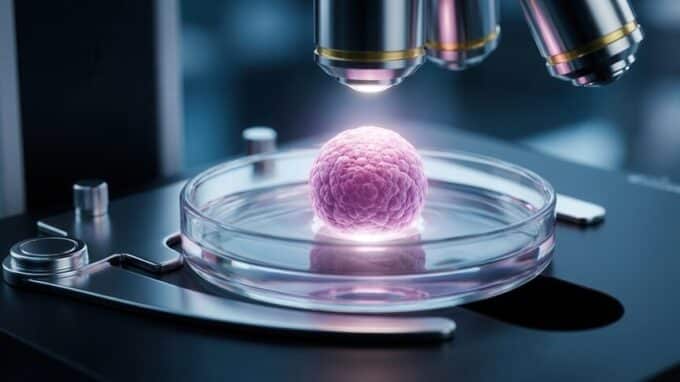
In Greece, a baby was born whose embryo had been frozen for more than 22 years. This extraordinary case raises an interesting medical question: How long can a human embryo remain frozen without losing its ability to develop?
An Embryo Does Not Age in a Freezer the Way a Human Does
In Athens, a girl was born in early September 2026 whose embryo had been created more than 22 years ago and subsequently cryopreserved. The mother, Cristina Rapti-Tzelepi, was 54 years old at the time of the birth. The girl was born on September 9 and weighed 3.49 kilograms. For the family, this story has a particularly personal background. The couple’s son, Giorgos, was born in 2004 following IVF treatment—from the same original group of embryos. In October 2025, he died in a traffic accident at the age of 21. Afterward, the couple decided to use one of the embryos that were still frozen.

The embryo was transferred in December 2025. A few months later, their daughter was born. But how can an embryo “survive” for so long? The key difference lies in the temperature. During cryopreservation, embryos are cooled to extremely low temperatures and are typically stored in liquid nitrogen. Under these conditions, the cells’ metabolic processes virtually cease.
This means that an embryo that has been frozen for 20 years is not biologically comparable to a 20-year-old embryo. During this time, there is no normal development or aging as occurs in a living organism. Modern techniques such as vitrification are designed to prevent harmful ice crystals from forming inside the cells during freezing. Upon subsequent thawing, the embryo is returned to normal conditions and can—provided it survives the thawing process and other requirements are met—be transferred.
Is there a Maximum Storage Period?
From a biological perspective, there is no simple figure such as “embryos can be frozen for a maximum of 25 or 30 years.” Rather, research to date suggests that long storage periods under suitable conditions do not necessarily impair the quality of a cryopreserved embryo. For example, studies have found no significant deterioration in certain pregnancy and neonatal outcomes due to longer storage times within the periods examined. However, very long storage periods have been studied much less thoroughly from a scientific perspective than short or medium-term periods.
This is an important point: The fact that one embryo was successfully stored for 22 years does not automatically mean that every embryo can be stored for 50 or 100 years. There is a lack of corresponding long-term data to support this. However, the cases documented to date show that storage over decades is, in principle, possible. Even before the case in Greece, pregnancies had been reported following very long periods of cryopreservation.
Why “Freezing” Isn’t Quite the Right Term
In everyday language, we say that an embryo is “frozen.” Medically, the process is more complicated. With traditional slow freezing, there is a risk that ice crystals will form and damage cell structures. With vitrification—a method widely used today—the goal is to transform the fluid inside the cells into a glass-like state so quickly and in such a controlled manner that hardly any harmful ice crystals form. During subsequent storage in liquid nitrogen, the embryo remains in this state. In a sense, time does not continue to pass biologically for it.
The transition between these states, however, can be problematic: Not every embryo survives thawing unscathed. Furthermore, a successful pregnancy depends on numerous other factors—including the quality of the embryo, the endometrium, and the woman’s age and overall health.
What Happens When an Embryo is Frozen and Thawed?
In order for an embryo to be stored for many years, its biological development must be brought to a near-complete standstill. To achieve this, embryos are typically cryopreserved in fertility medicine today using a process known as vitrification.
First, a special liquid is added to the embryo to protect its cells during freezing. The embryo is then cooled extremely rapidly to very low temperatures and is usually stored in liquid nitrogen at approximately minus 196 degrees Celsius. The rapid cooling is intended to prevent the formation of large ice crystals. Such crystals could damage cell membranes and other sensitive structures. At these temperatures, normal metabolic processes practically cease. The embryo therefore does not continue to develop during storage, nor does it age in the same way as a living organism.
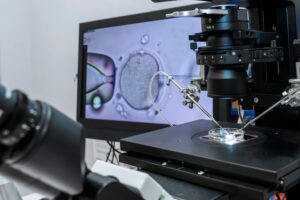
The thawing process must also be carried out in a highly controlled manner. The embryo is removed from the liquid nitrogen and warmed up in several steps. At the same time, the protective substances used during vitrification are removed and replaced with suitable fluids. The goal is to return the embryo as quickly and gently as possible to a state in which its cells can function normally. The embryo is then examined in the laboratory to determine whether it has survived cryopreservation and thawing and is continuing to develop.
If it survives the process, it can then be transferred to the uterus. Whether this actually results in a pregnancy, however, depends on other factors. Not every thawed embryo leads to a pregnancy. The Greek case therefore demonstrates one thing above all: The time an embryo spends in a frozen state does not necessarily correspond to its biological “aging.” An embryo cryopreserved for 22 years is not comparable to an embryo that would have continued to develop for 22 years. The crucial question is rather whether its cells survive cryopreservation, storage, and thawing intact.
22 Years is Therefore Extraordinary – But Not a Biological Expiration Date
The case from Greece is particularly noteworthy because more than two decades elapsed between the creation of the embryo and its use. The American news agency AP described this period as one of the longest known intervals between cryopreservation and a successful pregnancy, but at the same time emphasized that it is not an unambiguous world record.
It is therefore crucial to make a distinction: Medicine currently recognizes no fixed biological “expiration date” for a properly cryopreserved embryo. At the same time, there is also no reliable data proving that storage is practically unlimited in humans.
The Actual Limit May be the Law
How long an embryo may actually be stored is therefore not only a medical question, but also a legal and organizational one. Different countries have different rules regarding storage duration, parental consent, and the handling of embryos that are no longer intended for use. The costs and contractual terms of storage also play a role.
In Greece, another factor came into play in this particular case: Strict age restrictions applied to the treatment of the 54-year-old mother. The family therefore had to act within a limited time frame.
What Remains of the 22-year-old Embryo?
From a medical perspective, the most important insight from this case is not that an embryo has reached the age of “22 years.” Rather, it has spent those 22 years in a state in which its biological development was largely suspended. The case thus demonstrates above all the possibilities of modern reproductive medicine: An embryo can be cryopreserved for a very long time and still lead to a pregnancy.
However, the extent of this possibility has not yet been definitively determined. While 22 years have now been impressively documented, a precise biological upper limit cannot be deduced from this.
And this is precisely the scientifically interesting question behind the story from Greece: not “How old can an embryo get?” but rather, how long can human cells be preserved in a cryopreserved state under optimal conditions—and at what point are the limits set not by biology, but by medicine, technology, or legislation?
You may also be interested in...
-

You are likely wondering what comes next after having successfully completed your IVF process and…
-
It’s safe to say that many women would want to be mothers at some point.…
-
Children born through frozen embryo transfer have similar metabolic profiles to children born through fresh…