
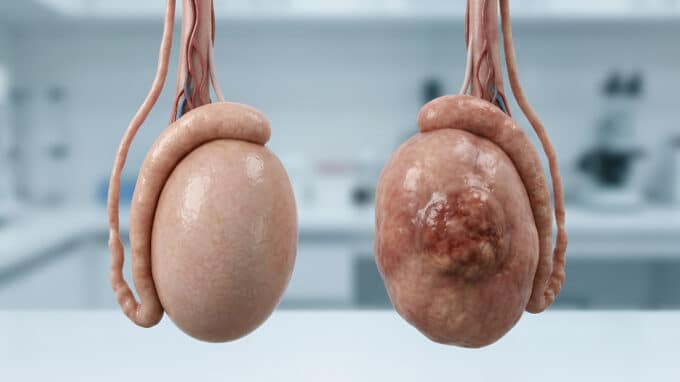
A 19-year-old man in the United Kingdom has become the first patient in the country to have his own testicular tissue—which had been frozen prior to his chemotherapy—reimplanted. Doctors hope that the tissue will once again be able to produce sperm. It is still unclear whether the treatment will be successful—but the procedure could open up new possibilities for young men who might lose their fertility as a result of cancer treatment.
Why Chemotherapy Can Jeopardize Future Fertility
Today, cancer treatment can save lives, but it sometimes leaves young patients with consequences that don’t become apparent until many years later. One of these is infertility. This poses a particular problem for boys and adolescents: those who have already passed puberty can often have their sperm frozen. However, this option is not available to a child who has not yet begun producing sperm.

This is precisely where a new method comes in, one that researchers have been developing for more than a decade. In Edinburgh in August 2026, doctors performed the first procedure of its kind in the United Kingdom, transplanting previously frozen testicular tissue back into the body of a young man. The 19-year-old had the tissue removed and frozen three years earlier, before undergoing high-dose chemotherapy and subsequently a bone marrow transplant to treat a severe blood disorder. The procedure is an important step in research on male fertility. However, it remains to be seen whether the transplanted tissue will actually produce sperm again.
Chemotherapy targets rapidly dividing cells. That is precisely what makes it so effective against many types of cancer. However, certain drugs can also damage the cells in the testicles that are needed for future sperm production. Depending on the treatment, the damage can be temporary or permanent. For an adult man, there is therefore an established option: sperm can be collected and frozen before treatment begins.
This method does not work for a boy before puberty. At this stage, his testicles do not yet contain mature sperm. Instead, they contain, among other things, so-called spermatogonial stem cells. Sperm production develops from these cells after puberty begins. These stem cells are therefore particularly important for long-term fertility.
A Piece of Testicle Instead of Frozen Sperm
The researchers’ idea is not to wait for sperm, but to preserve the tissue that contains the precursor cells for future sperm production. To do this, a small piece of testicular tissue is removed before a treatment that could potentially impair fertility. The tissue is then deep-frozen and stored. More than 1,200 patients in the United Kingdom and around 3,100 worldwide have now had testicular tissue frozen for possible future use. However, the method remains in the clinical research phase. The hope is that the tissue can be thawed years later and transplanted back into the body. There, the preserved stem cells could resume their original function and begin producing sperm again.

The British Patient Received his Own Tissue Back
The young man who recently underwent treatment had his testicular tissue frozen in 2023. He was 16 years old at the time. Before treatment, it was foreseeable that the necessary intensive therapy could jeopardize his future fertility. Three years later, tests showed that no sperm could be detected in his semen. In August 2026, doctors therefore transplanted back a portion of the previously frozen tissue. According to the treating team, the patient recovered well from the procedure. Now the crucial phase begins: The doctors must monitor whether the transplanted tissue survives, establishes a blood supply, and resumes its function. After about eight months, a sample of the transplanted tissue will be examined to determine whether sperm have formed within it.
It is Not Yet Clear Whether He Will be Able to Become a Father Later On
This caveat is crucial. The procedure itself does not yet mean that the young man is fertile again. While the scientists hope that the transplanted tissue will produce sperm once more, Whether this actually happens and whether the resulting sperm can later be used for assisted reproduction remains to be seen. The British patient himself has therefore also spoken cautiously about his future. He said the treatment has given him hope, but at the same time, it is not yet known whether it will work. For researchers, this very uncertainty is important: The procedure is a clinical research trial and not yet an established standard treatment.
An Important Breakthrough Has Already Come from Belgium
However, the British case is not entirely unique. In 2026, Belgian researchers reported on the first person in whom frozen immature testicular tissue from childhood actually showed signs of sperm production again following a later transplant. In this patient, the tissue had been frozen at the age of ten prior to a treatment that could have impaired fertility. Many years later, it was transplanted back into him as an adult.
After one year, the researchers found signs of active spermatogenesis in the transplanted tissue. Sperm were even successfully retrieved from one of the grafts. The result is considered an important proof of concept: It demonstrates for the first time in humans that immature testicular tissue can survive long-term storage and resume sperm production after subsequent re-transplantation.
However, this case also involved a single patient. The researchers therefore emphasize that no general success rate can yet be derived from this case. Furthermore, it remains unclear whether the retrieved sperm can actually be used for successful reproduction.
Why This Breakthrough Is Especially Important for Boys
For adults, fertility preservation prior to chemotherapy is relatively well established. A man can provide a sperm sample before treatment, which is then frozen. Later, it can be used, for example, in the context of artificial insemination. For a child before puberty, this option does not exist. This is precisely why research on testicular tissue is so important.
If the method proves effective in the long term, a boy could have a piece of testicular tissue frozen before undergoing fertility-damaging therapy. Years later—possibly only as an adult, when he wishes to have children—this tissue could be transplanted back. This would open up a window of opportunity that has been virtually unavailable until now.

What Happens to the Stem Cells in the Frozen Tissue?
The key component of the tissue is the spermatogonial stem cells. They are, in a sense, the precursor cells for future sperm production. After puberty, they can develop into mature sperm through several stages of development. Intensive chemotherapy can destroy these cells or damage them so severely that sufficient sperm production is no longer possible. If, on the other hand, they are harvested and frozen before treatment, they could theoretically be preserved for years. The challenge then lies in ensuring that the cells function again in a new environment after thawing. This is precisely what makes the current transplantation trials so significant.
The Research Has Taken More than a Decade
The treatment in Edinburgh did not come about suddenly. The University of Edinburgh has been working for more than ten years on a program to preserve fertility in boys who must undergo treatment that could potentially impair their fertility. Initially, the program focused on the retrieval and long-term storage of testicular tissue. Animal studies also provided important insights.
In non-human primates, it has already been demonstrated that frozen testicular tissue can produce sperm again after transplantation. In such research models, the sperm obtained from this tissue were subsequently even used for assisted reproduction, resulting in a live offspring. The crucial step now is to apply these findings to humans.

Not Yet a Standard Treatment
Despite the spectacular results, this method should not be equated with an already established fertility treatment. Professional societies point out that the clinical use of frozen testicular tissue in children still raises unresolved questions. These include, among other things, the quality of the frozen tissue, the number of stem cells obtained, long-term safety, and the tissue’s actual ability to produce functional sperm later on. Another important question concerns safety in the context of certain cancers: Theoretically, frozen tissue could still contain cancerous cells. Before a later transplant, it must therefore be carefully assessed whether the tissue can be used safely.
A New Path to Fertility After Cancer
For families with a seriously ill child, fertility is understandably not the most important concern at first. The focus is on successfully treating the disease. But if a child survives the illness, another question may arise years later: Will he or she be able to have children one day? This is precisely where the new method could fill an important gap.
The ability to preserve testicular tissue before puberty could mean in the future that fertility-damaging treatment does not necessarily have to spell the end of biological parenthood. This approach is not yet guaranteed. But the first human results show that the idea can indeed work biologically.
What Needs to Happen Next
In the case of the British patient, the primary focus now is on observing whether the transplanted tissue survives in the long term and becomes active again. If sperm production occurs, that would be another important step. Subsequently, it would need to be determined whether the sperm produced are sufficiently numerous and functional and whether they are suitable for assisted reproduction. After that, larger studies involving additional patients would be necessary. Only once the results are confirmed in multiple people will it be possible to assess how reliably the method works and for which patients it is suitable.
A Glimmer of Hope for Future Parenting
The transplant in Edinburgh is therefore less of a fully developed treatment and more of a glimpse into a possible future for fertility preservation. For boys who require intensive chemotherapy or other treatments that could potentially damage fertility before puberty, there has been no established way to access their own sperm later in life.
Freezing testicular tissue could one day close this gap. The British patient must now wait a few more months until it becomes clearer whether his transplanted tissue can actually produce sperm again. At the same time, this case—along with the initial results from Belgium—provides important evidence that the idea is no longer based solely on animal experiments. The hope of preserving one’s own fertility despite a serious illness is thus moving a step closer for some young patients.
You may also be interested in...
-

Testicular cancer is one of the less common types of cancer that typically affects men…
-
New research has found that the sperm of a crocodile has different properties than scientists…
-
A cancer diagnosis brings with it numerous physical and emotional challenges. For many men, however,…