Boron is a trace element that does not perform a single, clearly defined function in the human body, but is involved in several regulatory processes. Its potential significance for fertility does not result from a direct effect on egg cells or sperm, but from its influence on hormone metabolism, inflammatory processes, and the availability of other micronutrients. It is precisely these indirect effects that make boron interesting for people with hormonal or metabolic imbalances.
The Central Mechanism: Hormone Availability and Inflammation Regulation
Boron does not interfere with metabolism like a hormone, but it does influence the activity and availability of steroid hormones such as estrogen and testosterone. Studies show that boron can slow down the breakdown of these hormones and increase their biological effectiveness. The key point here is that boron does not stimulate hormone production in the strict sense, but rather stabilizes the hormonal environment in which these hormones act.

In addition, boron appears to have anti-inflammatory properties. Chronic low-grade inflammation is an often overlooked factor in fertility problems, as it can impair both hormone communication and germ cell function. Boron can lower inflammation markers and support antioxidant protective mechanisms. This improves the environment in which hormonal and reproductive processes take place.
Effect on Female Fertility
In women, boron is particularly relevant in connection with estrogen metabolism. Estrogen not only controls the menstrual cycle, but also influences the maturation of egg cells, the development of the uterine lining, and blood flow to the reproductive organs. Too rapid inactivation or a functional estrogen deficiency can disrupt these processes, even if laboratory values are within the normal range.
Boron can help stabilize the effect of estrogen by inhibiting its breakdown and promoting its binding to target tissues. This effect could be particularly relevant during phases of hormonal instability, such as with increasing age, high stress levels, or high levels of inflammation. This is not a hormonal therapy, but rather a subtle modulation of existing hormone signals.
Boron also plays a role in vitamin D metabolism. Vitamin D influences follicle maturation, immune balance in the uterus, and implantation capacity. Boron can prolong the half-life of vitamin D and thus indirectly enhance its effect. Here, too, boron does not act in isolation, but as a supporting factor in a complex hormonal network.
Effect on Male Fertility
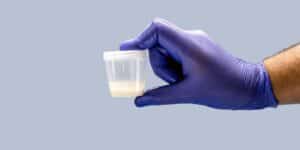
In men, the potential benefits of boron lie primarily in supporting testosterone availability and protecting sperm from oxidative stress. Testosterone is crucial for spermatogenesis, but it is not only the absolute amount that is relevant, but also the proportion of biologically active, free testosterone.
Studies show that boron can increase this free testosterone fraction without necessarily increasing overall production. At the same time, boron can reduce inflammatory and oxidative processes in the testicular environment. Oxidative stress is considered one of the most important factors for reduced sperm quality, as it can impair sperm motility, membrane integrity, and DNA stability.
Animal studies suggest that boron can improve sperm concentration and motility. The data available for humans is still limited, but the underlying mechanism is easy to understand: boron creates more favorable hormonal and cellular conditions under which spermatogenesis can proceed more efficiently. It is also important to note that boron does not act as a testosterone booster. It does not artificially shift hormone axes, but rather supports the body’s own regulation.
Boron: Dosage, Safety, and Classification
Human studies have mostly investigated boron amounts in the range of about 1 to 3 milligrams per day. These doses are above the average intake of many people, but are considered safe in the short term. However, very high or long-term supplementation should not be undertaken without professional supervision, as individual requirements vary greatly.

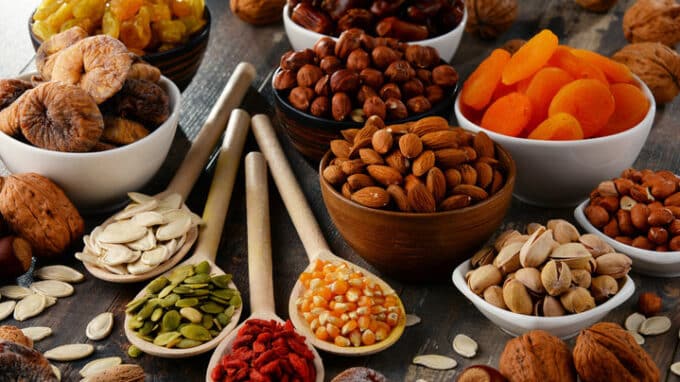
Boron can be obtained relatively easily through diet, especially from plant-based foods. Fruits such as apples, pears, grapes, and dried fruits contain relevant amounts. Nuts, legumes, avocados, and green leafy vegetables also contribute to boron intake. In these foods, boron is embedded in a matrix of fiber and secondary plant substances that complement its effects in a meaningful way.
Food vs. Supplements – What Makes Sense?
Boron from food has a slow and physiological effect. It supports long-term hormonal balance without overriding individual signaling pathways. Supplements can have a more targeted effect, but should be considered a temporary measure, for example in cases of proven low intake or increased demand.
For people who want to have children, this results in a pragmatic approach:
- First, regularly incorporate boron-rich foods into your diet.
- Reduce inflammatory factors (e.g., stress, highly processed foods).
- If hormonal imbalances persist, consider taking supplements.
Conclusion
Boron is not a classic fertility trace element and does not directly trigger ovulation or sperm formation. Its potential benefits lie in stabilizing hormonal conditions, reducing inflammatory stress, and supporting other hormone-relevant micronutrients such as vitamin D. In this indirect, regulatory sense, boron can be a useful component in a holistic fertility concept—especially when hormonal imbalances are not clearly pathological but functionally limited.
You may also be interested in...
-

New research has found that the sperm of a crocodile has different properties than scientists…
-
If you're a woman struggling with infertility, you can take solace in knowing that you…
-
You may have heard of the gut microbiome and its influence on a person's overall…