
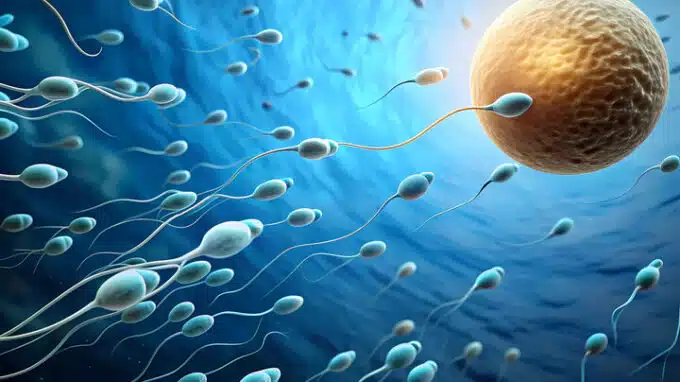
Fertilization is commonly portrayed as an intense competition in which millions of sperm compete for a single egg cell. However, new research by evolutionary biologists at Syracuse University, the University of Siena (Italy), and the University of Szeged (Hungary) paints a more complex picture. In some species, reproductive success may depend not only on competition but also on sperm working together.
The researchers studied arthropods, the vast group of animals that includes insects, spiders, crabs, and millipedes. They examined examples from throughout evolutionary history in which arthropod sperm formed organized groups or structures that could help them reach and fertilize an egg. This coordinated behavior, known as sperm conjugation, is changing scientists’ understanding of both reproduction and evolution.
How Sperm Cooperation Works
Sperm conjugation can be compared to a rowing team moving in unison. Scientists first documented this phenomenon more than 100 years ago, but it was generally considered rare. The new study, published in *Nature Communications*, shows that sperm cooperation is widespread among arthropods and has evolved independently on multiple occasions.
“Fertilization is often viewed as a competition between individual sperm, but in many species we observe that cells cooperate in ways that can influence reproductive success,” says Steve Dorus, professor of biology at Syracuse University’s College of Arts and Sciences (A&S) and co-author of the study. In many species, sperm-associated material (SAM) is involved in this process. This membrane-enclosed substance can bind sperm together or form structures around them that arrange the cells into groups. The researchers speculate that SAM may have contributed to the emergence of sperm conjugation, possibly initially as a mechanism for packaging or protecting the sperm.
A single sperm cell must traverse a difficult and highly complex female reproductive tract. By moving or interacting in groups, sperm can gain advantages in terms of mobility, organization, or overall performance. In these cases, fertilization becomes a coordinated effort rather than a competition among isolated cells. This finding challenges long-established assumptions about fertility. Scientists may need to look beyond the capabilities of individual sperm and pay closer attention to how group behavior affects reproductive outcomes.
An Evolutionary Pattern of Gain and Loss
The repeated emergence and disappearance of sperm conjugation is one of the study’s most remarkable findings. This strategy arose hundreds of millions of years ago but has been repeatedly gained and lost by various species over time. The analysis also concluded that the common ancestor of all insects possessed conjugated sperm.
To trace this history, the team conducted a comprehensive comparison of sperm structures in arthropods based on decades of previously published research. They examined the sperm traits of hundreds of species and plotted these traits on an evolutionary tree. This allowed the scientists to estimate when various forms of sperm cooperation emerged and how frequently they disappeared or reappeared.
The resulting timeline traces sperm conjugation and sperm-associated material (SAM) across the major animal lineages over the past 600 million years. It reveals a recurring pattern in which evolutionary innovations emerged, disappeared, and later reappeared. “Evolution has essentially been conducting the same experiment over and over again in different groups of arthropods,” said R. Antonio Gomez, a postdoctoral researcher in the Department of Biology at A&S and first author of the study. “This allows us not only to identify when sperm cooperation arises, but also when it disappears and reappears under different evolutionary conditions.”
According to the researchers, this recurring pattern illustrates the experimental nature of evolution. “Sperm are the fastest-evolving cell type,” said Scott Pitnick, Weeden Professor of Biology at A&S and senior author of the study. “They face the unique challenge of functioning outside the body in the complex environment of the female reproductive tract.”
Possible Implications for Fertility
Although the study focuses on evolutionary biology, its findings could also influence several other areas of research. One possibility is a more comprehensive understanding of fertility across the animal kingdom.
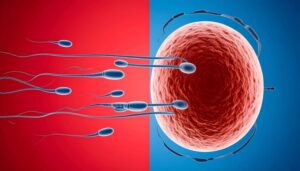
Pitnick describes fertilization as more of an obstacle course than a straight-line race. Sperm must navigate a complex environment and interact with the female reproductive tract in a variety of ways. Understanding how sperm work together or depend on shared biological structures could ultimately point scientists toward new avenues for studying human reproductive problems.
A New Target for Pest Control
The research could also support new methods for controlling harmful pests. Scientists are investigating whether sperm conjugation, or SAM, could be disrupted to impair reproduction in harmful species. One potential target is the invasive spotted lanternfly, which has increasingly become an agricultural problem in New York and other eastern states.
The sperm of the spotted lanternfly differ from the cooperative sperm found in many other arthropods. They do not form coordinated groups. Instead, each sperm cell is surrounded by a thick layer of SAM. “Their sperm are highly unusual,” said Pitnick. “They don’t form conjugates; instead, each individual sperm is completely embedded in this material, and we don’t even know how they move yet.”
Scientists still do not understand how these sperm move and function. However, this mystery could also present an opportunity. If SAM is essential for the lanternfly’s reproduction, disrupting this material could represent a highly specific way to control the species.
Why Does Sperm Cooperation Evolve?
One key question remains unanswered: Why does sperm cooperation evolve in the first place? One possibility is that cooperation improves movement through the reproductive tract. Another possibility is that grouped sperm help each other transport important molecules to specific locations.
Confirming these hypotheses is difficult because sperm observed on microscope slides often behave differently from sperm moving through the far more complex environment of the female body. Future studies will attempt to observe sperm groups within actual reproductive systems. The researchers also hope to identify the specific advantages and potential disadvantages of this cooperative behavior.
Cooperation and Competition Work Together
The findings provide a more general insight into biology. Cooperation and competition are not necessarily opposing forces. They can work together, and even microscopic cells can depend on a balance between the two.
“What makes this pattern so fascinating is that evolution repeatedly arrives at similar cooperative solutions across very different groups and over long periods of time,” says Dorus. “These examples remind us that cooperation can be just as important for biological success as competition.”
By studying how sperm coordinate to overcome reproductive challenges, scientists are uncovering new details about evolution, fertility, and the biological strategies that make life possible. The work also helps fill a major gap in our understanding of how complex reproductive traits have emerged and changed over hundreds of millions of years.
You may also be interested in...
-

There are numerous factors that make fertilization difficult or completely impossible. In many cases, the…
-
Motile sperm are difficult to collect using conventional cell sorters because they are susceptible to…
-
Male fertility is determined through many different factors. One of these factors is that of…